

- >>
- Reports

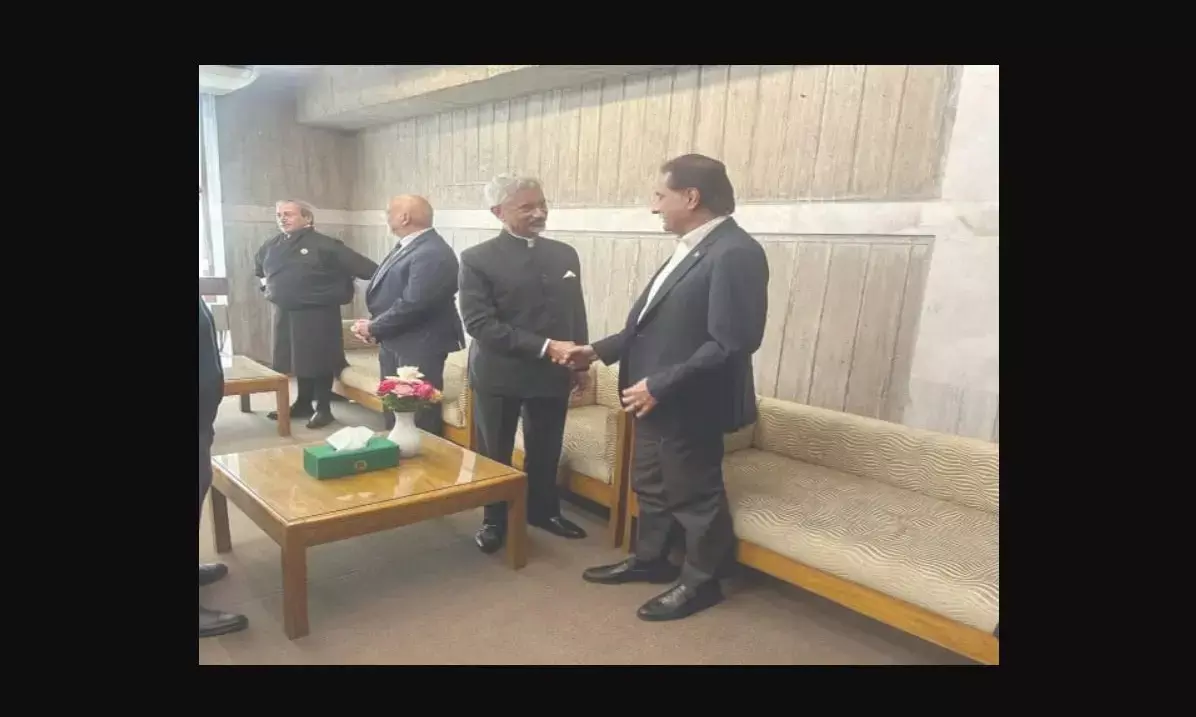
The fact that India’s Foreign Minister S.Jaishankar initiated a handshake with the Pakistan National Assembly Speaker Ayaz Sadiq in Dhaka on Wednesday, has sent ripples of excitement in Pakistan.
It is seen, albeit cautiously, as an early sign of a thaw in the relations between India and Pakistan which seemed to have broken irretrievably after the brief May 2025 air war between the two.
The exchange of greetings was the first high-level face-to-face interaction between two officials of the neighbours since their four-day military confrontation. The interaction took place on the sidelines of the funeral of former Bangladeshi Prime Minister and Bangladesh Nationalist Party (BNP) chairperson Khaleda Zia, who passed away on Tuesday after a prolonged illness.
The photograph of the handshake was put on the official X account of Bangladesh's Chief Executive Dr. Yunus. "Sardar Ayaz Sadiq, Speaker of the National Assembly of Pakistan, exchanges greetings with Indian External Affairs Minister S Jaishankar in Dhaka on Wednesday ahead of the funeral programme of the former Bangladesh Prime Minister Khaleda Zia. On this occasion, the Indian Foreign Minister Dr S Jaishankar personally walked over to the Speaker of the National Assembly and introduced himself during a handshake," the statement from Yunus’ office said.
It added that Jaishankar remarked during the brief exchange that he was "familiar with Speaker Ayaz Sadiq's personality."
The Indian government did not issue any statement on the interaction probably to keep the incident away from the Indian public’s eye.
While diplomatic handshakes are routine at multilateral events, the symbolism of this handshake has generated interest because of the sharply adversarial state of India-Pakistan relations over the past year and the hard-line posture adopted by New Delhi under the Bharatiya Janata Party (BJP) government to wards Pakistan.
Following the April 2025 Pahalgam attack in Jammu and Kashmir and the subsequent military conflict with Pakistan in May, India announced a policy of "no public engagement" with Pakistan in any form. That approach was not limited to diplomatic channels but extended to sports and cultural interactions as well.
When the Indian and Pakistani cricket teams faced each other during the Asia Cup in the UAE, Indian players, reportedly acting on government instructions, avoided the customary post-match handshake. The Indian women's team and junior teams later followed the same template, reinforcing New Delhi's policy of symbolic disengagement, the Pakistani daily “Express Tribune” said.
“Against this backdrop, the Jaishankar-Ayaz handshake has triggered debate over whether India may be reconsidering aspects of its public disengagement strategy, or whether the interaction should be viewed strictly as a matter of diplomatic courtesy at a solemn international event,” the daily said. .
“But analysts caution against reading too much into the episode. They note that informal interactions at funerals and multilateral gatherings do not necessarily indicate a policy shift. However, they also acknowledge that symbolism matters in diplomacy, particularly when relations are otherwise frozen,” the daily added.
Indeed, the handshake has acquired outsized significance. Social media platforms in both Pakistan and India were quick to amplify the image, with reactions ranging from cautious optimism to outright scepticism.
Jaishankar’s friendly gesture towards Sadiq was most probably meant to be noticed and deciphered in Bangladesh rather than in Pakistan.
The public display of cordiality by India, with Pakistan, however ephemeral, could have been designed to convey to the Interim Government of Dr. Muhammad Yunus and also to the Bangladesh Nationalist Party led by Tarique Rahman, that there is no sense in cultivating Islamabad to “counter” New Delhi because New Delhi is making up with Islamabad.
The Indian pretense of making up with Pakistan could continue, albeit in small installments until Bangladesh comes around to accept India’s concerns. On Thursday, India and Pakistan exchanged lists of nuclear installations and prisoners. The list exchange took place under the provisions of an agreement on the prohibition of attack against nuclear installations and facilities. The exchange was in continuation of a three-decade practice.
“Pakistan and India exchanged the lists of their respective nuclear installations pursuant to the agreement on Prohibition of Attacks against Nuclear Installations and Facilities between Pakistan and India signed on 31st December 1988, which came into force in 1991,” the Pakistan Foreign Office spokesman Tahir Andrabi said at the weekly press briefing.
The two countries also exchanged a list of prisoners under the consular access agreement signed on May 21, 2008. “The government of Pakistan today handed over a list of 257 Indian prisoners, including 199 fishermen and 58 other civilians in Pakistan’s custody, to the High Commission of India in Islamabad,” Andrabi said.
India will continue friendly gestures towards Pakistan until Dhaka comes round to addressing New Delhi’s concerns and to restoring the close relations that were broken by the July 2024 revolution which overthrew the India-friendly regime of Prime Minister Sheikh Hasina.
Reciprocally, India could address issues that had troubled Bangladesh. Simultaneously, India could liberalize trade and travel benefitting Bangladeshis. Trade and people to people ties, close as they tend to be because of geographic and economic realities, could, over time, make it difficult for Bangladesh to break out of the Indian sphere of influence and strike an alliance with Pakistan.
A long-term normalization of India-Pakistan relations cannot be read into Jaishankar’s handshake because the Hindu nationalist government of Prime Minister Narendra Modi has to be keep up tension with Pakistan at a high level to legitimize its existence and also to win elections that keep occurring ever so often in India.
The anti-Pakistan card yields handsome electoral dividends in India, and that, unfailingly.