
- >>
- Reports
In recent years, the fifth of August had turned out to be a turning point in the history of South Asia. Bangladesh, Pakistan and India saw momentous changes on August 5 in 2024, 2023 and 2019 respectively.
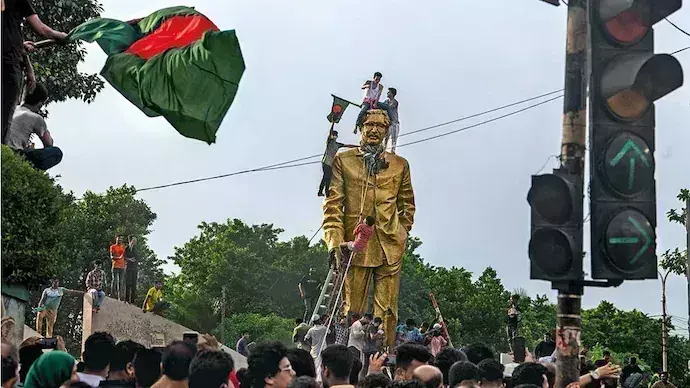
It was on August 5, 2024, that Sheikh Hasina, Bangladesh Prime Minister for 16 years, fled to India following a violent month-long student-led agitation for democracy.
On August 5, 2003, Pakistan’s most popular leader, Imran Khan of the Pakistan Tehreek-i-Insaf (PTI) party, was jailed for alleged corruption. There is no sign of his release.
On August 5, 2019, the Indian central government suddenly and insidiously revoked the 75 year old Art 370 of the Indian Constitution which had given autonomous Statehood to Muslim-majority Jammu and Kashmir. The revocation reduced the State to a centrally administered Union Territory with greatly reduced powers.
Bangladesh
On August 5, 2025, the first anniversary of the overthrow of the Awami League government led by Sheikh Hasina, the Chief Advisor of the Interim Government, Dr.Muhammad Yunus, read out the “July Resolution” embodying the policies and programs of the new Bangladesh.
The resolution recalled that democracy was disrupted under the rule of the Awami League through “domestic and external intrigues”. The Awami League’s “fascist” regime made undemocratic changes in the constitution to establish a one-party state. Malfeasance, abduction, murder, unlawful killings, suppression of speech marked Hasina’s rule.
In the name of development, the regime allowed corruption, looting of banks, and money laundering. The Awami League government, that was “loyal to external forces” had applied brutal force to suppress people’s rightful protests against “foreign tutelage” exploitation and domination. It held three “farcical” elections, in order to continue to cling to power.
Savage tyranny was applied by the Awami League government during the anti- discrimination student movement.
According to the “July Resolution” Dr. Muhammad Yunus’s Interim Government is committed to building the state and society free from “fascism, inequality and corruption”. It has promised good governance and fair elections, rule of law and economic and social justice.
It was resolved to bring to trial crimes involving oppression, violence and looting of state property, enforced disappearance and murder.
At the public meeting in Dhaka on August 5, Dr. Yunus read out of the July Resolution, and announced that parliamentary election will be held in February 2026.
The goodwill that greeted Yunus in August 2024 has retreated significantly according to neural observers. Pledges to revive the economy have remained only on paper. Inflation and unemployment are high. The banking sector is on the brink of collapse due to non-performing loans, which are 30% of total loans.
The World Bank has predicted a 3.3% growth in GDP in FY25, reducing it from its earlier projection of 4.1% made in October 2024. The IMF has cut its growth forecast for FY 2025 from 4.5% (made in last October) to 3.7%.
Reports suggest that criminal cases have been filed against 182 journalists, accreditation of about 167 journalists have been cancelled, and inquiries have been initiated against 85 senior journalists by the Bangladesh Financial Intelligence Unit. The system is so oppressive that bail pleas of senior journalists like Mozammel Babu, Shyamal Dutta, Farzana Rupa and Shakil Ahmed, have not been heard.
Extortion has become a social reality. Some of the student leaders of the anti-Hasina agitation have allegedly become millionaires in the past year. Ain o Salish Kendra (ASK), a leading human rights organisation had brought out a report claiming that at least 179 people were killed in mob attacks between August 2024 last year and June 23 this year.
A mob assaulted a former chief election commissioner and freedom fighter K.M. Nurul Huda. Thirty eminent citizens issued a joint statement condemning the mob attack on Huda.
Islamist radicals, who strongly back the Yunus regime, recently took to the streets demanding rejection of a Women's Reform Commission report that recommended equal rights for women in matters of inheritance, divorce, property and marriage. Videos of Islamist radicals stripping a woman's effigy and beating it with shoes went viral.
According to a report by Dhaka Tribune, more than 24 cases of rape were reported in the country between June 20 and June 29 this year. Even insiders in the Yunus regime have said that sexual violence is a “pandemic-level crisis,” according to The Telegraph of Kolkata.
The interim regime is systematically obliterating the memory of the founder of Bangladesh, Sheikh Mujibur Rahman. Though the July resolution says that the 1971 War of Liberation will be remembered, all signs indicate its obliteration and substitution by the July revolution.
Pakistan
On August 5, 2023, Pakistan crossed a political rubicon. Mass leader Imran Khan of the Pakistan Tehreek-i-Insaf party (PTI) was arrested on corruption charges, triggering violent protests nationwide.
Military installations were torched, the Lahore Army Corps Commander’s house was ransacked, the fortified Pakistan Army’s General Headquarters at Rawalpindi was attacked.
Imran’s party is now dormant following police repression. But even so, the leader is still in jail as the army, which controls Pakistan, wants him in jail till he apologises. But Imran is not one to apologise. He say he had done no wrong and had actually won the last elections.
India
It is now six years since the abrogation of Article 370 of the Constitution and the downgrading of the erstwhile State of Jammu and Kashmir into two Union Territories (UTs). Ladakh became a separate Union Territory in October 2019.
The decision of August 5, 2019 was billed as the turning point that would usher in peace and development, and pave the way for the closer integration of the Kashmir Valley with the rest of India. But the abrogation was followed by a total shut down of the internet and virtually all local leaders were detained.
Since then, political activity has resumed. A new government under the National Conference was formed after elections. But the NC leads a government with reduced powers. Just before the election, control over police and services was given to the Lieutenant Governor, limiting the authority of the elected government.
The NC government is pushing for full Statehood. But the Pahalgam terror attack on April 22 and the subsequent short war with Pakistan have thwarted possibilities of a return to Statehood. Chief Minister Omar Abdullah’s move to reinstate July 13 as Martyrs’ Day in the State to commemorate the police firing against demonstrators against Maharaja Hari Singh’s dictatorial rule has been frowned on by New Delhi.
However, New Delhi keeps arguing that the abrogation of Art 370 has curbed terrorism and improved the economy of the State. 28 terrorists have been killed in 2025 so far, down from 67 in 2024. Local recruitment has also fallen drastically from 129 in 2019 to just one this year.
According to the Indian media, production has begun in 359 industrial units. 1,424 units are in advanced stages of completion. J&K has seen a sharp rise in tax revenues. General Sales Tax collection increased by 12%, excise by 39%, and overall non-tax revenues rose by 25% between 2022 and 2024. The state’s GDP doubled from 2015-16 to 2023-24. By December 2026, power generation is expected to double.
However, the fiscal deficit remains high. The economy is heavily reliant on central grants which account for 70% of the expenditure.
In 2024, a record 3 million tourists visited J&K, and tourism contributed 7% to the GDP. But the Pahalgam attack of April 22, and the subsequent security lockdown of 50 tourist spots dealt a a severe blow to tourism, the mainstay of Kashmir’s economy.