

- >>
- Reports
Violence In Ladakh- The Background
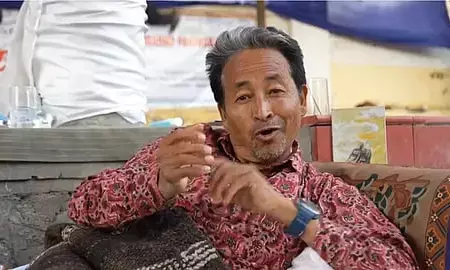
Ladakh, a vast mountainous region in the northern-most part of India bordering China and Pakistan, was on the boil in September. Forty one people were killed in police firing and scores were injured as they took to violence to press the government of India to yield to their long-standing demand for autonomy, democracy and constitutional protections.
Since 2019, the Ladakhis, led by the world-renowned climate activist and Magsaysay award winner, Sonam Wangchuk (59), have been demanding “Statehood” (Provincial status) with an elected local legislature and inclusion in the Indian constitution’s Sixth Schedule that gives indigenous tribal communities protections against encroachments by outsiders.
The Ladakhis, who are mainly Buddhists, consider themselves tribals and therefore, entitled to certain constitutional protections.
When a hunger strike by Wangchuk proved to be futile, youths (Gen Z) took to violence destroying State property. Four protesters fell to police bullets. Wangchuk ended his fast abruptly hoping to ease tension, but tension only mounted as the government arrested him under the stringent National Security Act and whisked him away to distant Rajasthan.
Charges against Wangchuk were grave - indulging anti-national activities, calling for a Nepal-type Gen Z or an Arab Spring type of revolt to change the regime, amassing wealth by questionable means, and money laundering.
The government did call for talks, but the agitators rejected it demanding an immediate and unconditional acceptance of their demands as they had agitated and waited for long already.
The impasse continues, with opinion in India sharply divided between those who deem the Ladakhis’ demands to be legitimate and call for the release of Wangchuk, and those holding ultra-nationalistic views who deem any protest by anybody as a national security threat to be put down with a heavy hand.
Indian political parties have not taken a stand, except the Congress whose leader Rahul Gandhi tweeted to say that he supported the Ladakhis’ demands and sought a judicial inquiry into the firing by the police. The Ladakh Congress party described the charges against Wangchuk as false, fanciful and vengeful.
When New Delhi abrogated Articles 370 and 35 A of the Indian constitution to take away Statehood from Jammu and Kashmir (including Ladakh) on August 5, 2019, making it a Union Territory to be governed directly, itclaimed it had national security in mind.
Jammu and Kashmir, including Ladakh, has long borders with Pakistan and China, two countries with which India has had military conflicts.
While Pakistan was accused of committing cross-border terrorism, China had grabbed land in Aksai Chin, Galwan, Hot Springs, Pangog Tso, Demchok and Chumar, all bordering Ladakh. In 1999 Pakistan had infiltrated Kargil and a full-scale war ensued. In 2020, 20 Indian soldiers were killed in a clash with Chinese troops in Galwan.
In August 2019, while Jammu and Kashmir was made a Union Territory with an elected legislature, Ladakh was made a Union Territory without a legislature. Thus, Ladakh was put completely under New Delhi‘s control with just one member in the Indian parliament to represent it.
Initially, the Ladakhis welcomed the separation of Ladakh from J and K as they were largely Buddhist while Kashmir and Jammu had a Muslim and Jammu majority respectively. The Ladakhis were largely tribal while the others were not. But soon, the Ladakhis also wanted an elected legislature. New Delhi was reluctant to yield to this mainly to keep the sensitive area bordering China, tightly under its grip.
Apart from political rights, the Ladakhis expected development initiatives as a place directly ruled by New Delhi. But nothing of note happened and Ladakh continued to languish under development. Only local leader Wangchuk, an engineer, was doing some developmental and education work through his NGOs.
Denial of development led to sour feelings and Wangchuk became the face of resentment. He particularly highlighted an alleged plan to parcel out vast amounts of land to Indian corporates for exploitation under the garb of development.
Ladakh’s demand for autonomy and participatory democracy goes back to 1931, when the Maharaja of Kashmir, Hari Singh, set up a Praja Sabha or People’s Assembly, consisting of 75 seats. Ladakh, then a district, was allotted only two seats, and that too to be filled by nomination. In 1981 two Buddhists were killed during a protest demanding abrogation of Art 370 as the Buddhist Ladakhis wanted separation from Muslim-dominated Jammu and Kashmir.
The Ladakh Buddhist Association (LBA) founded by Pandit Sridhar Kaul, a Kashmiri Hindu from Srinagar, had been voicing the Ladakhis' grievances. Although LBA’s primary mission was to promote Buddhist interests, foster social reforms, and preserve Ladakh’s culture and identity, it had been in the forefront of political and social struggles too.
In 1989, Thupstan Chhewang was elected the LBA’s president. Chhewang, assisted by Chering Dorjey Lakruk, Rigzin Spalbar, and Nuwan Rigzin Jora, initiated a movement to separate Ladakh from Jammu and Kashmir and secure Union Territory status. But when the Union Territory Status only increased subjugation, they started to demand Statehood.
During the P V Narasimha Rao government in the 1990s, the Ladakh Autonomous Hill Development Council (LAHDC) Act was passed, paving the way for hill councils in Leh and Kargil.
For decades, Leh was a stronghold of Congress. However, as its struggle for Union Territory and Hill Council status was ignored by the Congress-led Centre and the J&K government, the LBA found support from the Bharatiya Janata Party (BJP). The BJP gained a foothold in Leh. Several LBA leaders, including Chhewang and Lakruk, joined the BJP, which got its first Member of Parliament from Ladakh in the 2014 elections.
The abrogation of J&K’s special Constitutional status and its division into two Union Territories, J and K and Ladakh, in August 2019, was met with celebrations in Leh with the LBA viewing it as the culmination of its long struggle.
However, six years later, Ladakh’s political landscape shifted once again. Chhewang, Lakruk, and other former BJP allies, have left the BJP, and are now leading a renewed campaign for Ladakh’s statehood and inclusion under the Sixth Schedule of the Constitution.
A growing section of the Indian media, public intellectuals and media commentators with a military background, are calling for the release of Wangchuk fearing exploitation of the unrest by unfriendly foreign powers.
Chinese infiltration into the Ladakh struggle is particularly feared because of the shared border which is called the Line of Actual Control (LAC). The LAC is not the actual international border (which is disputed) but is the military-held line, indicating the deployment of Indian and Chinese army units on both sides.
Kargil which borders Gilgit Baltistan, an area held by Pakistan, lies on the Line of Control (LOC), which again is a military-held line and not an international border which is disputed.
Successive governments in New Delhi from 1947 onwards have viewed Jammu and Kashmir and Ladakh from an isolated national security and military security perspective. This has had a negative fallout and continues to agitate thepeople demanding statehood.