

- >>
- Reports
Europe Animosity Brings Putin Closer To India
Defence and economic relations in focus
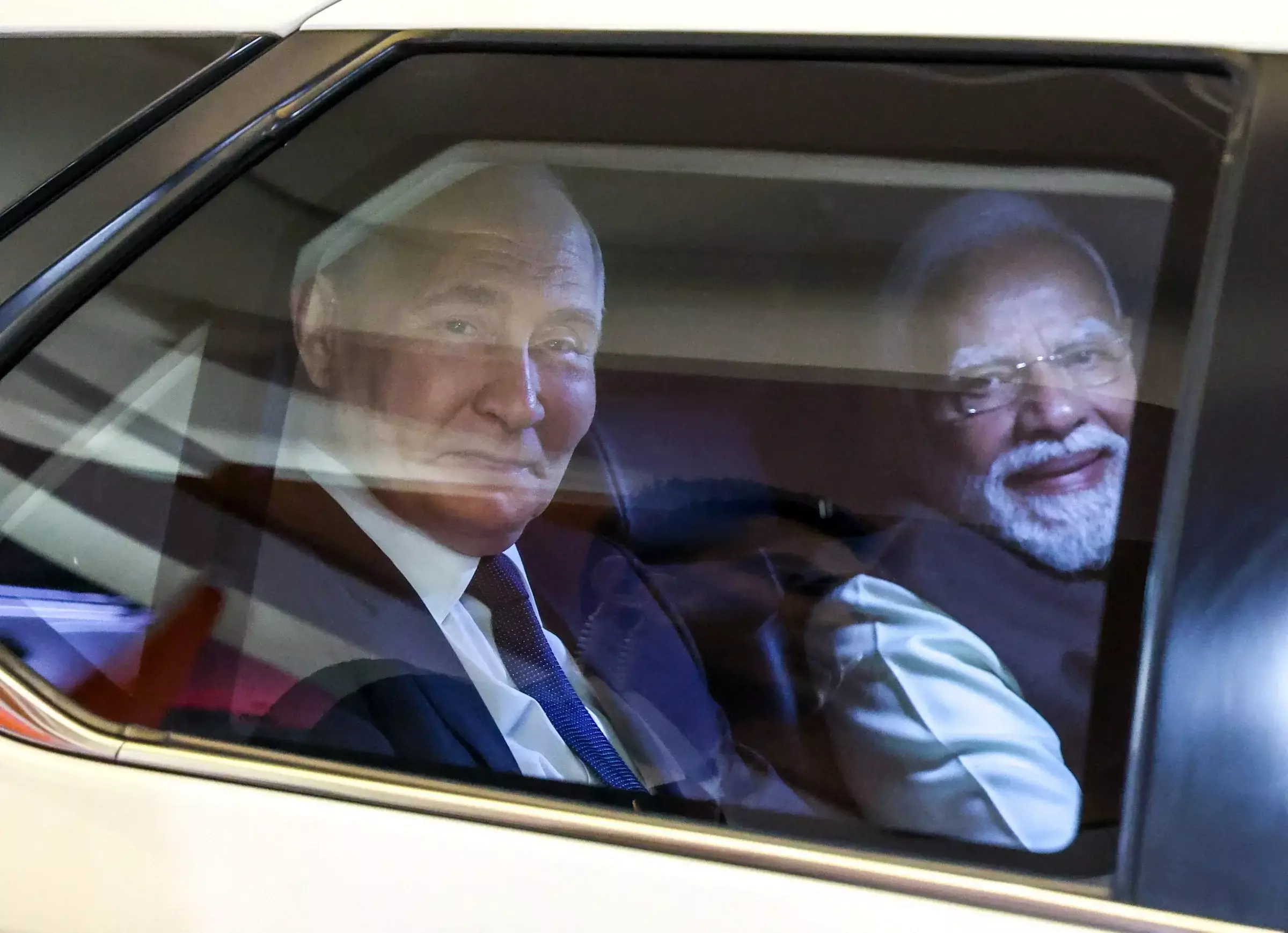
Russian President Vladimir Putin’s visit to India to attend the 23rd Indo-Russian summit on December 6 is expected to result in agreements for wide-ranging military and civilian technology sharing in all domains including land, air, sea, and space.
The visit takes place amidst two important developments – (1) the mounting threat to Russia from Germany, France and the UK; (2) the disruption caused to India’s exports to the US by President Donald Trump’s 50% tariff. Indian exports to the US fell by 9% causing layoffs.
The defence and economic agreements set to emerge from Putin’s visit to India are expected to further strengthen and deepen Russia-India relations and also help strengthen Putin’s resolve to meet the mounting threat from UK, Germany and France.
The problem for Russia emanates basically from Germany, France and UK, and not from the US so much.
Unlike the Europeans, US President Donald Trump has been working for a peaceful settlement of the Ukraine issue, albeit without success. But there is light at the end of the tunnel going by Putin’s remark that his talks with US special envoys Steve Witkoff and Jared Kushner were useful. Putin said that the talks were going step by step along the right path.
Speaking about the Moscow parleys, Trump said that his envoys strongly felt that Putin would like to make a deal. Trump added that Ukraine’s Zelensky also wanted a deal. Witkoff and Kushner would now talk to Ukraine’s chief negotiator Rustem Umerov.
But Britain, France and Germany are on the war path against Putin, feeling directly threatened by Russia’s continued military action against Ukraine.
This was directly reflected in an article for the “Times of India” jointly written by the Ambassadors of the UK, German, and France. The article, which appeared on the eve of Putin’s visit to India, was clearly meant to convey to New Delhi the inadvisability of giving any quarter to Putin, the alleged war monger.
The Russian Ambassador Denis Alipov replied to the European envoys, through an article saying that the European nations were responsible for the war as they had conspired to break solemn agreements. They overthrew Ukraine’s legitimate President, Viktor Yanukovich, to turn the country into a bulwark against Russia. The 2015 Minsk Accords designed to give the regions of Donetsk and Lugansk special status within the Ukrainian state were not honoured. Russia sent troops into Ukraine on February 24, 2022, citing Kiev’s failure to implement the Minsk agreements.
India was miffed with the European envoys for writing the article on the eve of Putin’s visit. “The Hindu” cited anonymous officials from India's External Affairs Ministry saying the article by the European envoys was “unusual and unacceptable.”
According to Air Marshal Anil Chopra (Retired), a former Director-General of the Centre for Air Power Studies in Delhi, expectations about Putin’s visit to Delhi are high. In a piece in “Russia Today” Chopra said that the general perception that India is inching towards the Western camp is not backed by ground realities.
Putin has made nine visits to India, three during Modi’s tenure, (2016, 2018, and 2021). This December will be his tenth. Modi has made seven visits to Russia, he pointed out.
Despite the threat of the US Countering America’s Adversaries Through Sanctions Act (CAATSA), India went ahead with the S-400 deal with Russia. Despite Western sanctions and tacit pressure, India stepped up petroleum purchase from Russia and continued rupee-based trade.
At the peak, the Indian armed forces had nearly 80% defence hardware of Soviet/Russian origin. The figure is now 60%.
In 1962, the Soviets agreed to transfer technology to co-produce the MiG-21 aircraft in India, something they had earlier denied to China. A more advanced strike variant of the MiG-23, the MiG-27, was assembled in India and later upgraded. Nearly 45% of the IAF’s fighter fleet is currently made up of the Sukhoi SU-30MKI air superiority fighter. Jointly developed with Russia in the early 2000, it is under license production in India.
Specially made for the IAF, the An-32 medium transport aircraft started inducting in 1984. Of the 125 bought, nearly 100 aircraft are still operating and have been upgraded. IL-76s along with An-32 are the workhorse of the IAF.
India also received its first set of missiles from the Soviets. The K-13 was the first-generation air-to-air missile that came with the MiG-21. The R-73, R-27, and R-77 RVVAE were among those that followed. Similarly, the SA-2 (Dvina) was India’s first surface-to-air missile. The SA-3 Pechora and SAM-8 joined the armed forces later.
The state-of-the-art, jointly developed Indo-Russian BrahMos cruise missile is already inducted in the Indian Armed Forces in large numbers. The IAF has also inducted the formidable S-400 air defence system. Three units have been delivered and two more systems will be inducted by 2026.
The Indian Navy’s air arm includes the Ilyushin IL38, Tupolev Tu-142M, and many Kamov Ka-25, Ka-28, and Ka-31 helicopters. Aircraft carrier INS Vikramaditya (the former Russian Admiral Gorshkov) is an important element of the navy. The navy also inducted carrier-capable MiG-29Ks.
At the Dubai Airshow in November, Russia announced an offer of full licensed production of the Su-57 in India, along with unrestricted transfer of technology – a level of access no Western defence partner has ever offered India, Air Marshal Chopra said.
“Russia is proposing an initial supply of Su-57E fighters produced in Russia, followed by manufacturing in India with increased indigenous content. This goes far beyond assembly from imported kits. Russia is willing to open the entire fifth-generation ecosystem, which includes engines, sensors, stealth materials, avionics, and other classified systems. Russia is also prepared to provide technological learning in areas such as fifth-generation engines, optics, AESA radar, artificial intelligence, low-signature technologies, and advanced air weapons, many of which have been denied by the West. The reported base price of the aircraft is unbelievably as little as $45 million. The Su-57 is being termed as the ‘mother of all offers’, with complete technology transfer and co-production in India,”” Chopra added.
Expansion of the Kudankulam Nuclear Power Plant in Tamil Nadu is on the cards. As on date, only two of the six units are operational.
Russia supports India’s forthcoming first human space flight, the “Gaganyaan” Mission. Russia will also push to partner in India’s AIP submarine program and offer to jointly design and develop conventional submarines with advanced technology access, as part of the P-75I project. Air-independent propulsion (AIP), or air-independent power, is a marine propulsion technology that allows a non-nuclear submarine to operate without access to atmospheric oxygen.
Two frigates, the INS Tushil and INS Tamala, were recently built by Russia at the Yantar Shipyard, while the remaining two are being built at the Goa Shipyard Ltd (GSL) in India through technology transfer.
Russia is reportedly expanding its shipbuilding cooperation with India, with two Indian shipyards being considered for the construction of four non-nuclear icebreakers. Russian shipbuilding officials have offered New Delhi their nuclear-powered design for an Indian Navy aircraft carrier, according to reports.
The Goa Shipyard will also build 24 river-sea class cargo ships for Russian clients in the Caspian Sea by 2027. Cooperation with India in shipbuilding has benefits for Russia, as the unit cost per vessel is projected to be half of what it would cost Russian shipbuilders.
Russia recently signed the Reciprocal Exchange of Logistics Agreement to facilitate military cooperation, allowing both nations’ armed forces to use each other’s bases and facilities for logistical support.
Herman Gref, CEO and Chairman of the Executive Board of Russia’s largest bank Sberbank met the media and announced that Russia and India have been carrying out large-scale transactions without the use of ‘third party’ technology.
Gref also said that Sberbank has launched “First-India”, a closed-end mutual fund focused on Nifty50 index that will facilitate greater Russian investments in the Indian stock market.
“The Hindu” reports that India and Russia are expected to sign an agreement that will indicate Russia’s greater willingness to open its labour market for Indian blue-collar workers.