

- >>
- Reports
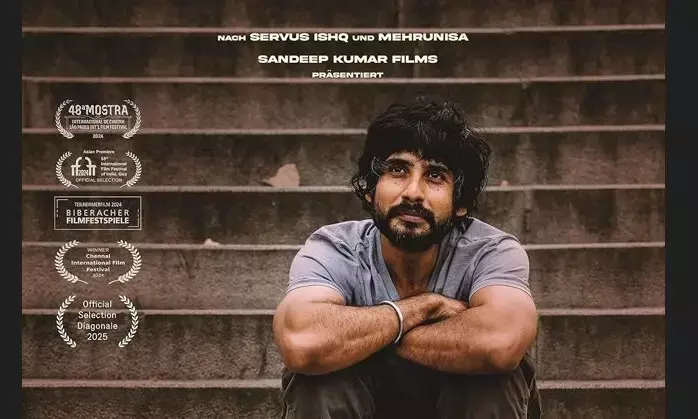
“Happy”, a feature film directed by Sandeep Kumar, an Austrian film maker of Indian origin will be screened at the 30th European Union Film Festival (EUFF) that opens in Delhi on October 31.
Director Kumar told The Citizen that he has tried to expose the universal desire for happiness also of those who seem to live in a world of plenty.
Curator Artur Zaborski said that 28 films in 29 languages out of which 13 are by female film makers are chosen for the festival, exploring themes of migration, identity, love, defiance, hope and more. While deeply rooted in European culture and society, each story resonates universally, reflecting themes that spark conversations across the world today.
Cinema has always been a bridge, connecting people, cultures, and ideas beyond geography and language. The films to be screened at the festival reflect the diversity, creativity, and emotional depth of contemporary Europe.
This year’s programme is more than a showcase of award-winning cinema. It is a connect between continents and generations. From the frozen landscapes of Scandinavia to the sun-drenched streets of Southern Europe, each film carries its own rhythm, humour, and soul together revealing something profoundly universal about the human experience, including the power of hope and resilience.
Crossing borders and generations, the EUFF2025 lineup is a window to Europe, showcasing cinema’s ability to bring closer cultures, spark dialogues, create shared human experiences and forge lasting bonds between India and Europe.
Such is the story of “Happy” as well, an illegal Indian immigrant in the Austrian capital of Vienna facing deportation. Happy’s life at present is exactly the opposite of his name. On the screen Happy is a very unhappy man and his nightmare is that he will be separated from his Vienna-born daughter if he is sent back to India. It is a heart wrenching thought that Happy’s little girl will be orphaned after he is forced to leave Europe even as her father is alive but on another continent.
Happy is not a criminal but he is being treated like one. Why? That is the question.
What is it that gives courage to human beings like Happy to wake up every day and to continue their struggle for survival in the face of numerous obstacles, many of them man-made? That is the other question. Migration happens when livelihood is snatched, homes of ordinary citizens are bull dozed and countries bombed. Then people scatter like flower petals in a storm to safer havens.
When will human beings realise that it is inhuman to make life difficult for other human beings, especially for those who have less resources and influence than others? Happy’s head spins with countless questions that puzzle him about existence but he has no answer to the injustice practiced around him.
For three decades the EUFF has been bringing cinema similar to “Happy” to India as part of an Indo-European cultural exchange, highlighting cinema’s unique power to unite people. Films that invite dialogue between generations, between traditions and modernity, and between cultures that seem different yet feel deeply familiar are chosen with care.
There are films that speak of love and loss, identity and belonging, courage and transformation that are encouraged to participate. Films that tell stories that don’t just entertain but also inspire reflection and conversation long after the lights are back are listed.
Sahidur Rahaman who plays the lead role is a Mumbai based actor who learnt the German language in four months as preparation for the character of Happy. Rahaman is a National School of Drama graduate and he has been doing theatre for over two decades. Playing Happy has been very special for him.
Rahaman told The Citizen that he has no words to express what a spiritual experience it was for a Bengali from a rural background like him to play the role of a down and out and troubled Punjabi in the heart of Europe. As a young man he recalled he was most inspired by “Baazigar”, the Shahrukh Khan starrer and ever since he had made up his mind to take up acting as a career. He has been groomed also by theatre guru Barry John.
It is the hope of Zaborski, a cultural journalist from Poland whose work spans Polish, American, Canadian, and Swedish media that the festival becomes a space for discovery for Indian audiences to find not only Europe on screen but also themselves, their emotions, their questions, their dreams. Because in the end, great cinema doesn’t belong to one nation. It belongs to everyone willing to feel, to think, and to see the world through someone else’s eyes.
For Indian audiences, EUFF25 is an opportunity to see Europe not as a single continent, but as a mosaic of voices, each distinct, yet connected by shared values of empathy, curiosity, and resilience.
As several continents around the globe struggle with wars, genocide in some places and never ending injustices, this is a chance for audiences to come across characters who challenge conventions, artists who dare to question the world, and storytellers who use cinema as an act of hope.
The hope that cinema is able to open many more hearts, spark ideas, and remind the world of the shared humanity that connects us beyond borders.
The EUFF is an annual event organised by the EU Delegation to India along with Member States. The film festival brings the finest and the biggest curation of European cinema, and in 2025, EUFF celebrates 30 remarkable years in India, marking three decades of cinematic dialogue that connects cultures, inspires conversations, and brings Europe’s diverse stories to Indian audiences.
This year, the festival goes beyond Delhi, with exciting new chapters in Bengaluru and Hyderabad.
“Happy” screens in Delhi on November 2 and in Bengaluru on November 7.