

- >>
- Reports
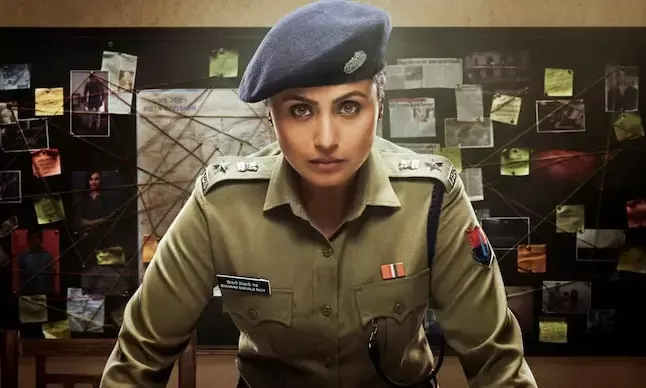
The recently coined term “Sheroes” probably refers to films in which the woman or women do not need a hero to back them or romance them or lead to a happily-ever-after ending.
There may or may not be men in their lives but these men are effectively marginalised in both the script and the celluloid space of these films and there is no dearth of such films in recent history.
This story begins with four wonderful off-beat yet mainstream films in which Rani Mukherjee plays the lead. The first one is Sanjay Leela Bhansali’s Black where she is a girl with multiple disabilities growing from a little girl to a girl appearing for her graduation exams, partially blind, unable to speak and hear yet bubbly and ready-to-go after the initial hiccups. Her portrayal as Naina Mathur in Hichki (2018) is one of the most lovable young teachers one has encountered in Bollywood films in a long, long while.
In one film after another, over the past decade, Rani Mukherjee has proved that she does not need a romantic angle, a romantic hero in her past, present or future, does not need a song-dance number to make a film stand on its feet with the solid support of a wonderful supporting cast.
“Success” says Rani Mukherjee through her films Black, No One Killed Jessica, Mardaani 1 and 2 and Hichki, “does not depend on bubbling youth, on a six abs hero with shoulders you can lean on, on generous skin shows through song-dance numbers.”
However, it is both a challenge and a tough job to sustain the suspense, the thrills and the excitement over every frame showing a woman police officer bashing up many macho males in her challenge to capture the villain responsible - usually a young man in a franchise that spreads itself over three films with the same Shivani Shivaji Roy performed by the one and only Rani Mukherjee. So, Mardaani 3, begins well enough through part 3 but only till the interval.
The film opens with the abduction of two girls – one from a privileged background and the other from a marginalised one — from the outskirts of a diplomat’s farmhouse in Bulandshahr in western Uttar Pradesh, forcing Shivani to navigate official pressures, criminal syndicates, and moral dilemmas.
One of the two girls is the only daughter of a VIP so her rescue is much more precious than that of the other very poor girl who no one seems to bother about. Her superiors keep on insisting, even warning Shivani that the diplomat’s daughter needs to be rescued and in not so many words, ‘the other girl can go to hell.’ The finding of the diplomat’s daughter is of prime significance because it carries diplomatic wrangles.
Shivani decides otherwise, insisting that it is equally important for both the girls to be rescued. In her frantic search for the two missing girls, she shockingly uncovers that little girls from terribly impoverished families are going missing over the recent past and this, despite the warnings of her superiors, including a minister, sets her off on a hot chase to find out why only girls who have not reached puberty are disappearing. The ones who have already reached puberty, are eliminated, just like that.
She discovers that there is a beggar mafia behind this entire scheme headed by none other than a strange woman, Amma who queens over the mafia, the girls and the men who run the show under her command. Is the film a victim of “franchise fatigue” as the saying in recent litany goes.
Maybe yes, maybe no. But other than the very imaginatively choreographed fight scenes including the attack on Shivani’s innocent husband (Jishu Sengupta) and the sudden brainwave of the script to thrust a US-returned, gentle-speaking NGO-head into the story. He turns out to be the very man who suffocates the diplomat’s daughter to death.
So far, so good. But the reason why the little girls are abducted, shipped away to Sri Lanka for some terrible medical experiments sounds too hollow even for a modern fairy tale.
While Rani Mukherjee leaves no stone unturned to prove that she is the best in such strong roles where she does not need a man, including her husband’s shoulder to cry on, the other actors are convincing too. Mallika Prasad as the wicked Amma is as terrifying as she is scripted to be but her death with a bomb planted in her abdomen is just too much salt in an already salted dish.
The background score dotted with loud sound effects to underscore the violence is quite convincing and so is the cinematography and the editing both of which are very challenging for the said technicians though the editing tends to slip at times towards the end in the scene showing girls dying in a hospital ward of cancer somewhere in Sri Lanka!
Director Abhiraj Minawalla handles the material with restraint. The film is often equally thrilling and entertaining specially when you see a woman physically overpowering a bunch of men confidently and with a moral purpose behind every thought and action none of which is carefully planned as decisions must be made organically on the spur of the moment.
Mardaani 3 is by no means a feminist statement though Shivani’s constant question towards the end, “why girls alone?” might lead us in that direction. Being a woman does not really make much difference to her choices and decisions. Or to her moral principles.
The uniform she wears might be her profession. But beneath that khaki uniform and stern personality, she is also a morally strong human being who does not stop at planning the murder and the slow poisoning of the two villains – Amma and her adopted son, the NGO head who dies of the very cancer he cold-bloodedly kidnapped and killed the little girls for.
The acting by the actors is stellar to say the least and so is the rapport between and among them.
Mardaani 3 neither glorifies nor glamorizes violence. But the director, scriptwriter and cinematographer at no point shy away from showing violence at its graphic worst without quite making you feel sick.
Perceptions have dramatically altered. Newspaper headlines, TV grabs, ad campaigns and Bollywood — virtually every media platform has been feeding to create a very progressive and modern face of India’s women which are mostly cosmetic or spiced up to add the needed glamour.
The reality, unfortunately, hasn’t changed much. Contemporary Bollywood cinema as a medium of mass appeal which inspires, influences and motivates the audience, also has another use for the woman image within its framework that sometimes peeps out and offers a powerful potential that defies, confronts and challenges patriarchy in addition to reality and romance.
Mardaani 3, despite its focus on a woman cop, points this out in bold capitals. But I do not think the franchise should go on. It has exhausted itself. Seriously.