

- >>
- Reports
Pakistan-Taliban Relations Dip To Breaking Point
Border conflict even as Afghan FM on official visit to India
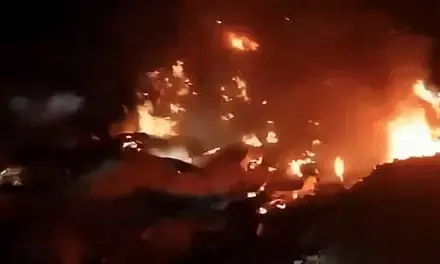
Troubled relations between Pakistan and Taliban-ruled Afghanistan have nosedived towards a breaking point.
On Sunday, an armed conflict broke out with Pakistan capturing 19 Afghan posts. Many Afghan Taliban terrorists present at the posts were killed and the rest fled for their lives, the Pakistani media said.
The fight is over Pakistan’s long standing charge that the Taliban- ruled Afghanistan is sponsoring cross border terrorist attacks by its proxies, Tehrik-i-Taliban Pakistan (TTP) and the Khawarij (Islamic rebels) in Pakistan’s border province of Khyber Pakhtunkhwa.
But the Afghan Taliban and the Kabul government deny any links with the TTP.
Pakistani President Asif Ali Zardari and Prime Minister Shehbaz Sharif on Sunday asserted that there would be “no compromise” on Pakistan’s sovereignty. Zardari also condemned the Afghanistan interim government’s ‘turning away’ from the Kashmiris’ struggle for freedom from India.
Saudi Arabia, Qatar, Iran have called for restraint. While the intervention of these wealthy and influential Islamic countries will doubtless bring about an end to the hostilities, the political issues between the two countries especially cross border terrorism from Afghanistan are unlikely to see a solution.
The Taliban regime as well as the TTP and the Khawarij are radical Islamists with an agenda to convert Pakistan into a Shariah compliant Islamic country and Pakistan being a modern South Asian country will not yield to such demands.
Speaking of the depredations of the Tehrik-i-Taliban Pakistan (TTP) in Khyber Pakhtunkhwa Province (KP) Pakistan’s military spokesman, Lt.General Ahmed Sharif Chaudhry said last week that in the 14,535 counter operations conducted in KP in 2024, 769 terrorists (including 58 Afghan terrorists) were killed. In addition, 272 army and Frontier Corps personnel, 140 policemen and 165 civilians lost their lives.
In 2025 (up to September 15) 10,115 counter-terror operations were conducted in which 970 terrorists were killed and 311 Pakistan troops lost their lives. Last Friday, 11 Pakistani soldiers were killed in a clash with Islamist militants in Tirah on the Pak-Afghan border.
On the same day, the Taliban-led government accused Pakistan of carrying out airstrikes on Kabul itself. Sources in Pakistan told Reuters that a vehicle used by the leader of the Tehrik-i-Taliban Pakistan (TTP), Noor Wali Mehsud, was targeted in the airstrike but it was unclear if he was killed.
An Afghan Defence Ministry statement on the airstrikes said - "This is an unprecedented, violent and provocative act in the history of Afghanistan and Pakistan. If the situation escalates further following these actions, the consequences will be the responsibility of the Pakistani military."
Pakistan neither denied nor accepted the air strike. But it did say that patience with the Taliban regime was running out.
Lt. General A.S. Chaudhry, the military spokesman, said - " To protect the lives of the people of Pakistan, we are doing, and will continue to do, whatever is necessary. Our demand to Afghanistan is that its soil must not be used for terrorism against Pakistan."
Taking note of TTP’s activities, the Pakistan army’s Corps Commanders’ conference last Wednesday pledged to continue operations “across all domains” to crush the TTP and the Baloch separatists, hinting at hot pursuit into Afghan territory.
It is no secret that the Taliban government has hosted terrorists of various persuasions on Afghan soil. In 2022, the US took out Al Qaeda chief Ayman al-Zawahiri in Kabul.
International contact groups comprising Pakistan, India, China, Russia and other Asian countries, have been calling upon the Taliban not to allow its soil to be used by terrorists to mount attacks on other countries. The latest appeal came on October 7 from a group which met in Moscow under the “Moscow Format”. For the record the Taliban government has agreed to this, both now and earlier in 2020 when it signed a joint pact with the United States.
However, Pakistan’s military spokesperson ruled out international help in striking terrorist havens in Afghanistan. While Pakistan will keep on engaging the international community, the responsibility to protect the lives and properties of the people of Pakistan will be with the State of Pakistan and its military, the spokesman clarified.
The TTP has been fighting to overthrow the Pakistan government and to replace it with a strictly Islamic one on the lines of the Taliban regime in Afghanistan. Pakistan accuses the Afghan Taliban and the Taliban government in Kabul of sponsoring the TTP, giving it bases and other facilities.
Islamabad also accuses New Delhi of supporting the Kabul-TTP nexus, but New Delhi considers the charge baseless. Pakistan sees a connection between the heightened TTP activity with the warmth developing between the Taliban regime and New Delhi.
Following the visit of the Taliban Foreign Minister Amir Khan Muttaqi to India this month, there will be diplomatic upgrading of the missions in Kabul and New Delhi, but short of outright recognition.
According to Najam Sethi, a leading Pakistani political commentator, if Afghanistan continues to sponsor cross border terrorism, Pakistan might engineer a regime change in Kabul to counter cross border terrorism, making use of factions within the Afghan Taliban that are against the present Establishment.
According to Sethi, Pakistan has already opted for hot pursuit across the Pakistan-Afghanistan border. But the long term aim would be to exploit differences within the Kabul regime and the Afghan Taliban to bring about a regime change, he added.
According to AP, Afghans have needs that cannot be fulfilled through the edicts and ideology of the Taliban. Kandahar-based Hibatullah Akhundzada has led the Taliban from insurgency to authority since his appointment in 2016, but till date, he has not been able to achieve his goals because of internal differences which are buried deep.
There are pockets in Taliban that want lifting of bans on women and girls, or at least modifying them. They want greater global engagement and policy modifications to go with them. But Akhujdzada and his coterie have suppressed these demands.
Interior Minister Sirajuddin Haqqani, an advocate of global engagement, has been weakened. Since November, Akhundzada has direct control over Afghanistan’s weapons and military equipment, sidelining the Interior Ministry and the Defence Ministry run by Mullah Mohammad Yaqoob, whose father founded the Taliban.
In January, political deputy Sher Abbas Stanikzai rebuked Akhundzada stating the education bans had no basis in Islamic law, or Sharia. The result - Stanikzai had to leave Afghanistan.
There is opposition to the Taliban’s policies among the public too, but it is not voiced because there is no credible alternative yet to the Taliban.
Moreover, there is a growing belief in the international community in the Taliban’s staying power. Therefore, the Taliban regime is getting recognition. But according to the UK-based International Institute for Strategic Studies, the world is actually on a drive to “appease” the evil Taliban.
However, the testing time for Taliban will be coming soon, AP adds.
“Until April, the US was the largest donor to Afghanistan, where more than half of the population relies on aid to survive. President Trump terminated the emergency assistance due to concerns that the Taliban were benefiting from such aid. But without aid, thousands of Afghans, including women, will lose their jobs, as nongovernmental organizations and agencies scale back their work or shut down. The loss of jobs, contracts, and the shrinking humanitarian footprint will also equate to a loss in revenue for the Taliban.”
Meanwhile, Pakistan has been pushing out tens of thousands of Afghan refugees from its soil, accusing them of crimes including drug trafficking. With these expulsions, Afghanistan will no longer benefit from remittances sent from those working in Pakistan.
India has promised to build houses for the returnees, but it will not be enough to meet the humongous need.
Aid officials told AP that frustration and an increase in tensions will trigger spontaneous violence as people compete for resources and services. Observers feel that the emerging fault lines could be used by agents of change whether located within or outside Afghanistan.
Pakistan could also use its growing clout in Washington DC to get the US involved in tackling the Taliban and its proxies. Trump might lend an ear to Pakistan as he has a conflict with the Taliban over his demand for the return of the USAF base in Bagram.
Cover Photograph social media