
- >>
- Reports
Elections in Tamil Nadu, Kerala, Assam and Puducherry are to be held on April 9. They will be an acid test for major political parties. Victory or defeat, could, even if only vaguely, indicate the direction of the political wind ahead of the all-India parliamentary elections in 2029.
Despite fierce controversies over voter list revisions, alliance frictions, governance critiques, and new political entrants, most pre-poll surveys suggest continuity for incumbent-led fronts in Tamil Nadu and Assam. Kerala could be an outlier.
While the “old order” shows resilience, factors like welfare delivery, unemployment, law and order, identity politics, and the impact of the Special Intensive Revision (SIR) of the electoral rolls could still sway outcomes in tight contests.
The Election Commission of India’s Special Intensive Revision (SIR) of electoral rolls, supposedly intended to remove alleged illegal immigrants from Bangladesh, duplicates, deceased voters, and untraceable entries, has been a hot controversy in Assam and Tamil Nadu (besides West Bengal that will go for polls on April 23 and 29).
The ruling parties in Tamil Nadu and West Bengal have strongly criticised the SIR, alleging a disproportionate targeting of poor, illiterate, and minority Muslim voters through rigorous and unfair document demands. Reports of hundreds of thousands facing scrutiny or deletion fuelled claims of disenfranchisement and political discrimination. The Supreme Court eased some documentary requirements, but doubts about fairness continue.
In Assam, the process aligns more closely with the ruling National Democratic Alliances’ long-standing “anti-infiltration from Bangladesh” narrative. But the Congress, the TMC, and the DMK see it as a ruse to win elections through elimination.
These elections also reflect broader national undercurrents such as the BJP’s expansion drive in East and South India, the staying power of regional leaders, and the battle between welfare populism and anti-incumbency.
In Tamil Nadu, there is an enigmatic new player, popular actor Vijay’s Tamilaga Vettri Kazhagam (TVK). Vijay has injected volatility, though limited organisational depth may cap his seat gains despite promising vote shares.
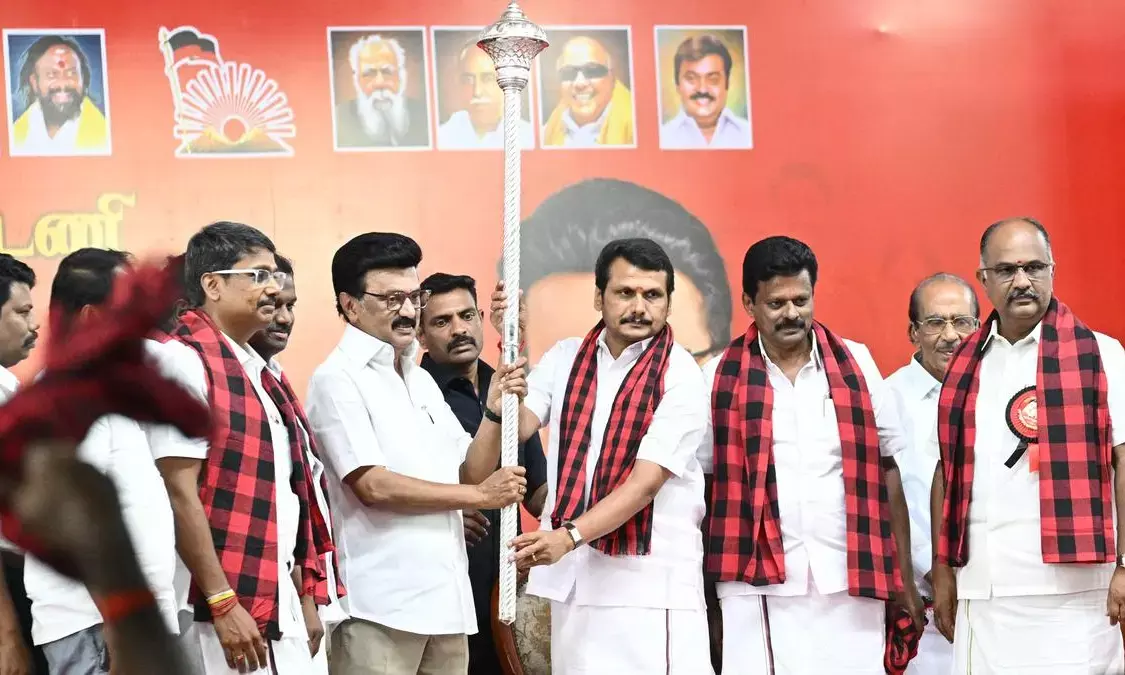
Tamil Nadu has 234 seats, and to win, the target is 118. Tamil Nadu’s Dravidian politics pits the ruling DMK (led by Chief Minister M.K. Stalin since 2021) against the AIADMK-led NDA (including BJP).
The DMK-led alliance, which includes the Congress, highlights flagship welfare schemes like the Kalaignar Magalir Urimai Thogai (women’s monthly cash support), free bus travel for women, and school breakfast programs. These have built strong loyalty among women, rural, and semi-urban voters. The alliance also claims high GDP growth and a social justice focus.
Explaining the aim of the welfare schemes targeting women, DMK MP, Kanimozhi has said that they are meant to bring women to the public sphere from the confines of their homes by lessening their burdens. The free bus ticket scheme would enable them to go to their workplaces at no cost. The double burner gas stoves given would enable them to finish their kitchen work fast. These are not meaningless give-aways, Kanimozhi points out.
Opponents of the DMK target unemployment, law and order lapses, and corruption. Actor-politician Vijay’s debutant TVK appeals to youth and anti-establishment voters. Seeman’s Naam Tamilar Katchi (NTK) plays on Tamil pride and alleged discrimination against Tamils by non-Tamils in Tamil Nadu itself.
The DMK and the Congress stress on the discrimination against Tamil Nadu and other States being practiced by the BJP-led Central government, with the DMK stressing attempts to impose Hindi.
Both the DMK and the Congress point to the danger posed by the BJP/NDA to secularism and federalism, both basic tenets of the Indian constitution. Both oppose the NDA’s Hindu nationalist agenda.
The AIADMK-led alliance which includes the BJP, avoid the above mentioned issues and turn its guns on the DMK’s “corrupt” practices and high-handedness. Vijay’s TVK plays on the theme of change, saying that the DMK and AIADMK are stale, having been in power since 1967.
Recent pre-poll surveys show variations but lean toward DMK continuity in most cases. Lok Poll projects the DMK alliance to get 181 to 189 seats ( with a 40.1% vote share). The AIADMK-NDA is placed at 38 to 42 seats (with 29% vote share , and the TVK is at 8 to 10 seats despite a 23.9% vote share.
Poll Tracker estimates the DMK alliance to get 172 to 178 seats ( with a 42.7% vote share), with TVK at 6 to 12 (with a 19.2% vote share).
However, some surveys (including VoteVibe and IANS-Matrize) indicate a much tighter race, with the AIADMK alliance potentially getting 106 to 127 seats).
The split in the opposition between the AIADMK-NDA alliance and the TVK, benefits the DMK. The consolidation of minorities against the BJP’s communal image plays a part in adding to the DMK’s strength. However, even as a comfortable DMK win is projected in several polls, the contest on the ground could be closer.
Kerala or Keralam, as it is now known, has 140 seats up for grabs and the majority needed is 71. It is a traditional bipolar contest with an emerging NDA posing some sort of challenge, at least notionally.
The ruling Left Democratic Front (LDF), led by the CPI(M) and Chief Minister Pinarayi Vijayan, seeks an unprecedented third straight term on its welfare and governance record. The United Democratic Front (UDF), led by the Congress, capitalises on anti-incumbency sentiments, citing alleged administrative fatigue, corruption, nepotism, and unemployment.
The BJP-led NDA positions itself as a right-wing alternative, targeting Hindu and Syrian Christian voters, who seem to be in conflict with the Muslims who are a substantial section of Kerala’s population.
The BJP is eyeing breakthroughs in southern Kerala districts like Thiruvananthapuram where the new middle class or the “aspirational classes” see Prime Minister Narendra Modi is a good light.
Multiple surveys describe a cliffhanger. Manorama-C Voter gives the UDF a slight edge (69 to 81 seats, with a 39% vote share), the LDF 57 to 69 (with a 36% vote share) and the NDA-BJP 1 to 5 seats.
The Lokpoll, CORE-Mathrubhumi, and VoteVibe show the UDF and the LDF going neck-and-neck, with ranges like 64 to 86 for the UDF and 51 to 78 for the LDF. The NDA gains modestly but remains limited.
Vote shares hover in the 36 to 45% band for the two main fronts. No decisive wave exists. So, marginal seats and small swings could prove crucial.
Chief Minister Pinarayi Vijayan’s image is polarised. He is respected for firmness but criticised for non-delivery. The general take is that the UDF might edge the LDF out this time round largely due to a desire for change.
Assam has 126 seats, and the target for winning is 64. The BJP-led NDA, in power since 2016 and under Chief Minister Himanta Biswa Sarma since 2021, has campaigned on infrastructure development, women’s welfare (the Orunodoi, Swanirbhar Naari schemes), border security, and strong anti-illegal immigration measures.
The Congress-led INDIA bloc highlights floods, high corruption, and unprecedented and unconstitutional communal polarisation. But recent defections from the Congress to the BJP have weakened the INDIA block.
However, it has to be granted that the Congress has been reluctant to take up the cause of the persecuted Muslims for fear of alienating the Hindu Assamese majority. The result - Sarma has played the anti-Muslim or more precisely the anti-Bengaladeshi illegal immigrant card successfully.
Mutual accusations have added intensity to the campaigns. But these may not derail the pro-incumbency trend in Assam. Sarma accuses his rival Congress leader Gaurav Gogoi of being a Pakistani agent because he visited Pakistan. And the Congress alleges that Sarma and his wife have amassed wealth through questionable means including properties worth millions of dollars abroad. Mrs.Sarma is also alleged to possess several foreign passports.
Pre-poll surveys predict a comfortable NDA hat-trick with 87 to 98 seats (with a 44% vote share). The Congress bloc is likely to get 26 to 36. Sarma dominates as the preferred Chief Minister with 47 to 48% approval.
With the NDA alliance holding 86 seats currently, a third term appears likely, driven by women and youth support. And alleged illegal immigration remains emotive and divisive
Pudhucherry has 30 elected seats plus 3 nominated. A party has to get 16 to be in the government.
The Incumbent NDA (comprising the All India N.R. Congress led by Chief Minister N. Rangaswamy, and the BJP) stresses continuity and close ties with the all-powerful BJP-led Central government.
The INDIA bloc (Congress + DMK) grapples with seat-sharing issues. Smaller players like TVK and others could influence margins of victory or defeat.
Available surveys and ground reports give the NDA a narrow but workable edge for a majority (projected as 14 to 17 seats), with Rangaswamy as a strong personal draw.
Though Puducherry is surrounded by Tamil Nadu on three sides, it has developed a different ideology, which has been Indian nationalistic rather than Dravidian. This is because it was under French rule till 1954. It had an Indian nationalist movement and not a Dravidian-separatist movement. Neither Hindi imposition nor the BJP’s Hindutva are major concerns there. Hence the brighter prospects of the Rangaswamy Congress-BJP alliance.
Despite the “storm” of electoral revision controversies, alliance brittleness, new entrants, and sharp rhetoric, pre-poll surveys largely point to the elections following the beaten track. What is expected is a DMK continuity in Tamil Nadu (though tighter than some think), NDA’s hold in Assam, and likely NDA return in Puducherry.
Kerala, however, stands out, with the UDF enjoying a slight edge in a genuinely open race.