

- >>
- Reports
Two neighbours –Thailand and Cambodia –with the majority of their populations adherents of Buddhism, had entered into what could become an extended conflict. The cause –the centuries old Khmer Prasat Ta Moan Thon temple, close to the border in Thailand which is claimed by both countries.
There had been long-standing tensions between the two countries regarding ownership of temples –not just Prasat Ta Moan Thon but others also. For instance, in 2008, a dispute over an 11th-century Hindu temple led to fighting over years and artillery exchanges in 2011 leading to a dozen deaths.
For over a century the two neighbours- who share a 817 kilometre land border- have claimed sovereignty over un-demarcated points. The border disputes are the legacy left by the French who had colonised Cambodia and first mapped the border in 1907.
The current episode, the worst in this decade, started in February 2025 when Thai police were said to have stopped Cambodian tourists from singing their national anthem at Prasat Ta Moan Thon.
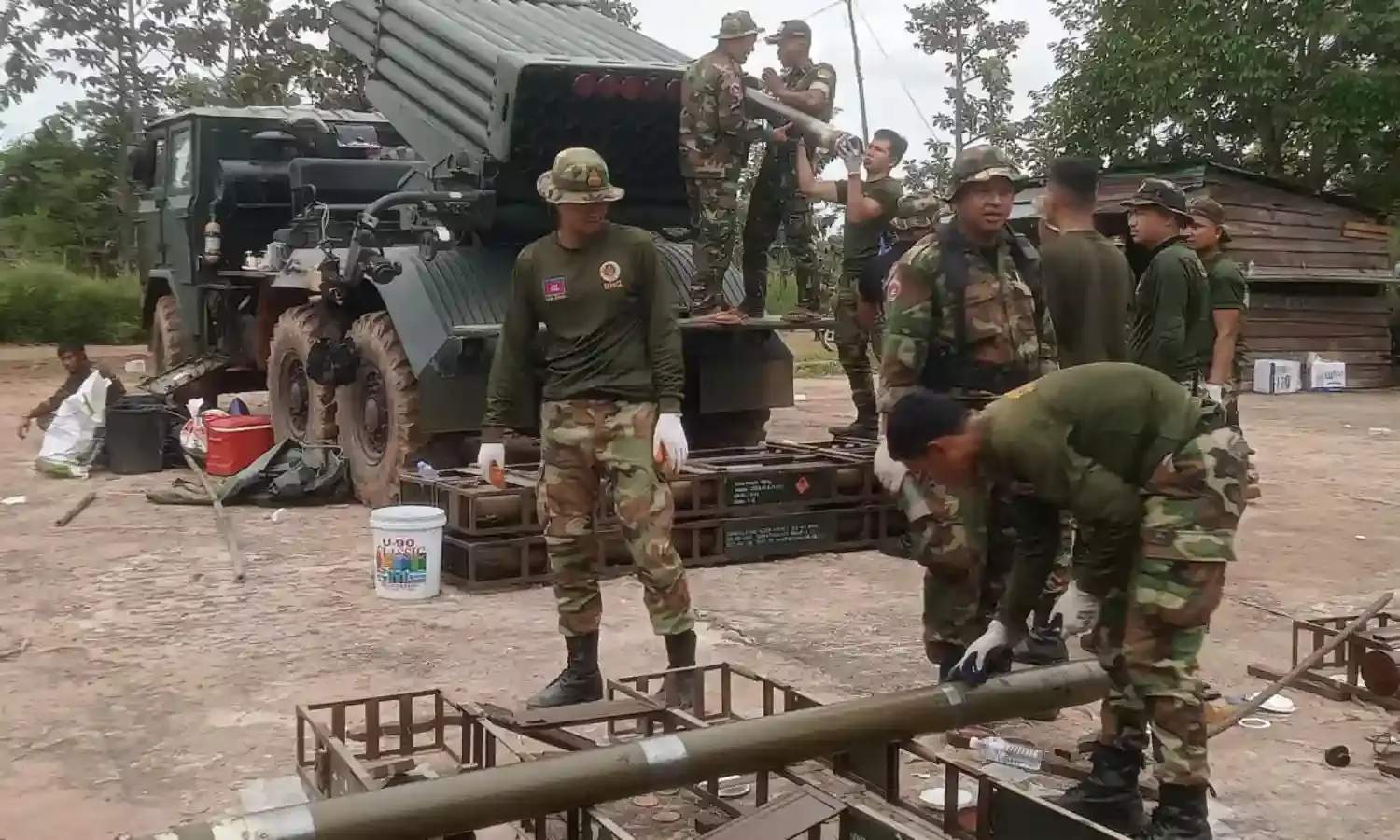
In May 2025 a Cambodian soldier was killed in a brief conflict. Both sides accused each other of starting the conflict. Then tensions spilled over in the last week of July 2025 when land mines injured several Thai soldiers. Subsequent clashes involved ground troops, artillery exchanges, and bombings.
Thai fighters bombed Cambodia whose military said its forces launched long-range rockets along the Thai border. Cambodia said Thailand had used internationally banned clusters while Thailand claimed Cambodia had fired long-range rockets into civilian areas.
Thailand declared martial law on 25th July in eight districts along the border while Cambodian officials said that Thai troops had opened fire at a temple in Surin. Cambodian Prime Minister Hun Manet had said that his country had no choice but to give an armed response to what he termed an armed invasion.
The five day fighting had led to around 38,000 civilians in Cambodia and almost 140,000 in Thailand fleeing the border areas. The toll was given as 32 people killed, and tens of thousands displaced.
While the fighting continued both sides claimed that they did not wish to fight and wanted the issue to be resolved through dialogue. Yet both had escalated the problem through the reinforcement of forces.
The Royal Thai Government justified the reinforcements to counter Cambodian moves with the Thai army accusing Cambodian soldiers and civilians of repeated incursions into Thailand's territory.
Cambodian Prime Minister Hun Manet said his country was only defending itself. Cambodia claimed to have gained control over territory around Ta Moan and Ta Krabei, along with six other contested sites, after pushing back Thai troops. Acting Thai Prime Minister Phumtham Wechayachai had told the media that the border fighting “could develop into war”.
Cambodia claimed that in June it had sought intervention by the International Court of Justice to resolve its disputes with Thailand but the Thais said they did not recognise the court's jurisdiction and wanted a bilateral approach.
It was Malaysia- that took the lead this time to broker a ceasefire and dialogue. China and the USA were also roped in.
Anwar Ibrahim, the Prime Minister of Malaysia and the current chair of ASEAN, said he had spoken by phone with the leaders of Thailand and Cambodia. China was worried by the conflict given its economic interests in Southeast Asia and Thailand had been a long-term ally of the USA.
The efforts by Anwar Ibrahim; possibly Chinese intervention; and phone calls from President Trump seemed to have resulted in the meeting between Malaysia's Prime Minister, Cambodia's Prime Minister Hun Manet, and Thailand's acting Prime Minister Wechayachai in Putrajaya on July 28.
The meeting led to a ceasefire starting at midnight on that day. At a press conference with the leaders of the two protagonist countries Anwar said that the ceasefire was a vital first step towards restoration of peace and security. The development was welcomed by the UN Secretary General and by American President Donald Trump – who characteristically claimed full credit for having achieved “PEACE”
What next? There is a degree of scepticism that the ceasefire will hold given the long history of disputes and distrust. The Thai army accused Cambodian troops of attacks after the ceasefire.
It is tragic that faith in God which should be a unifying force has increasingly become a cause of hostility and conflict. All religions teach peace, tolerance, coexistence and humanity. Non-violence and peaceful conduct are core principles of Buddhism.
It is therefore unfathomable just how these principles get warped and man-made representations of God and his Prophets make the world descend into an orgy of killing and destruction-either in the name of nationalism based on religion or sometimes just based on religion.
One can only hope that these two neighbours will find within themselves the strength to keep away from violence-something that would be possible only through a sincere application of the fundamental teachings of the faith of the majority of their people.