

- >>
- Reports
Padatik Studio Theater II never fails to surprise us with its unique experimental forays into theatre and sometimes, cinema, literature and the like.
On January 4, 2026, two cultural stalwarts of Kolkata, namely Navin Kishore, founder-proprietor of Seagull Books and architect-cum-actor-director Anubha Fatehpuria presented a unique performance entitled Mother of 1084: Performing the Documentary as a tribute to the late Mahasweta Devi on her centenary year.
This “performance” was no exception except that the audience, including this critic, expected a theatrical performance instead of the novelty that took us by pleasant surprise.
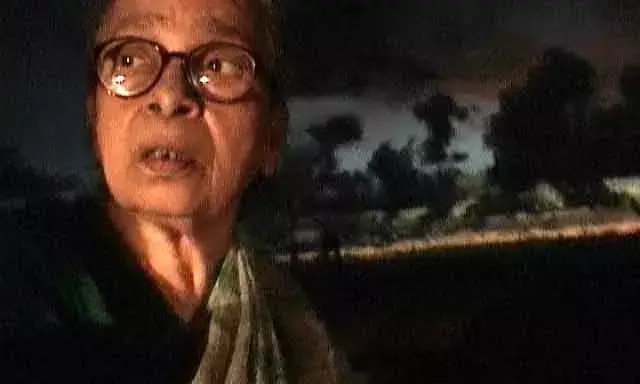
It is NOT a conventional play with actors filling the space with dialogue, action and using the proscenium space as and when. It comprised of a television screen in the centre with some interviews of the writer put together as a comprehensive film by filmmaker Pushan Kripalani while the interviews were done by Navin Kishore who happened to know Mahasweta Devi quite closely and has even gone ahead to publish some significant English translations of her original Bengali works under his famous banner, Seagull Books which defined a history of its own.
The proscenium itself was compartmentalized into three sections. While the central space was filled with a large television screen, it was flanked by two chairs occupied by Navin Kishore and Anubha Fatehpuria respectively.
Navin Kishore journeyed back into his long interactions with the writer-revolutionary known as much for her writing as she is for her fight for the rights of the Adivasis and Dalits in part of West Bengal and beyond where her literature, along the way, blended seamlessly with her activist persona right through the interviews.
Born in 1926 in united Bengal, Mahasweta Devi is one of India's foremost literary personalities. She is a prolific author of short fiction and novels; a deeply politico-social activist who has been working with and for tribals and marginal communities of eastern India for years. Her empirical research into oral history of the cultures and memories of tribal communities is the first of its kind in India.
Her powerful, haunting tales of exploitation and struggle are seen as rich sites of feminist discourse by leading scholars. Her innovative use of language has expanded the parameters of Bengali as a language of literary expression, achieved by imbibing and interweaving tribal dialects into her writing.
She is still known as having been a strong, no-nonsense and brutally frank political social activist working with and for tribals and marginal communities like landless labourers of eastern India. She tried to see society and judge history from the grassroots level, from the people's point of view that holds true of her first book, Rani of Jhansi.
This process eventually took her to the tribals and other marginalised non-tribal people in the 1970s. She turned her attention to the marginalized tribals and untouchable poor of eastern India, particularly Bihar and West Bengal. She travelled widely across Palamau, Chhota Nagpur, and the Santhal Parganas, living with and building an intimate connection with them.
She wrote in The Economic and Political Weekly, Frontier, etc leading newspapers and journals, drawing on first-hand experience. She wrote not only fiction but also hundreds of newspaper reports on them, particularly on the so-called criminal tribes notified by the British as 'criminal tribes' in 1871. She has written over 100 published novels, 400 short stories, edited Jim Corbett’s writing.
She was with around 60 Lodhas and Shabars of West Bengal who were reportedly being killed for either theft or for dacoity. But not a single receiver of stolen goods had been brought to book. When Budhan Sabar, a member of the Sabar Khedia tribe of Akarbaid in Purulia district West Bengal, was mercilessly killed by the police on February 17, 1998, Mahasweta Devi, as president of the Paschim Banga Khedia Sabar Kalyan Samity (of which Budhan was a member) filed a Public Interest Litigation in the Calcutta High Court. The responsible police officers were suspended, a CBI inquiry was initiated, and Budhan’s widow was awarded a compensation of Rs.100, 000.
She had great respect for tribals. She was both angry and sad that we have no respect for the superior and ancient wisdom of the tribal, for his rational and practical nature.
“How civilized they are is proved by the fact that they do not hate children, there is no dowry system, the groom pays the bride, widow remarriage is the norm, the younger brother can marry the elder brother's widow. Living together in most non-Hindu tribes is not a sin - both man and woman can marry later or marry different persons. Divorce is easy to obtain and man and woman are free to remarry. I have seen this among the Khedia Sabars who are the most civilised, wise human beings I have met,” she would proudly say.
“I don’t want people to rise in revolt with guns. But I want to make them angry about injustice and inequality” she said. In the series of interviews the audience was witness to, Mahasweta Devi also shed light on the lesser-known facts of her personal life, her two marriages, both of which broke down eventually for which she does not blame anyone except herself, her truncated relationship with her only son and her attempt to take her own life at a critical point.
These filmed and televised interviews with Mahasweta Devi were flanked by the live readings and recitations by the two anchors, namely Navin Kishore who also read out his own poems as tributes to Mahasweta and Anubha Fatehpuria, known as much for her excellent diction, her performance and her command over every kind of theatre and acting one can think of.
The brochure claims: “Navin’s poems of our city, more conversations, we revisit her life in a ‘travelogue’ that weaves in and out of her story – a young woman writer trying to make her mark in a male-dominated, publishing world, trying to make her mark in a male-dominated publishing world, coming of age both as wife and mother, a relationship with her once-estranged son – and the story of a nation in the throes of a freedom struggle.”
The ‘performance’ adds a new layer of meaning to the term ‘performance’ as we understand it.