
- >>
- Reports

Last year, my sister and my sister-in-law’s husband both had difficult deaths. Worse, the caregivers, themselves old, had to go through nightmarish situations, running to and from hospitals, phoning doctors and relatives, arranging for house help, visiting banks, etc. We were aware of palliative care, but knew not who could guide us.
Palliative care is a part of end-of-life care. Palliative care covers more than prevention of bedsores, and pain and nausea relief. It includes care of patients with chronic, life-limiting conditions, battling poverty, buying wheelchairs, trolleys, arranging for occupational therapists, getting home visits from trained social workers and nursing aids, etc.
Although many or most hospices cater to cancer patients, there are people with Parkinsons, Alzheimer’s, several organ malfunctioning conditions, with congenital incurable defects that are disabling, for whom life can be a long nightmare. This, couple with poverty makes it hell on earth.
Jerry Pinto, whose brilliant novel, ‘Em and the Big Hoom’ won him the Windham-Campbell prize for fiction and the Sahitya Academy Award in 2016, wrote in it how his family coped with his mother’s clinical depression, and how she suffered. His sensitivity comes out in his fiction and poetry. He has also won the National Film Award for Best Book on Cinema in 2007 for the biography of actress Helen, titled The Life and Times of an H-Bomb.
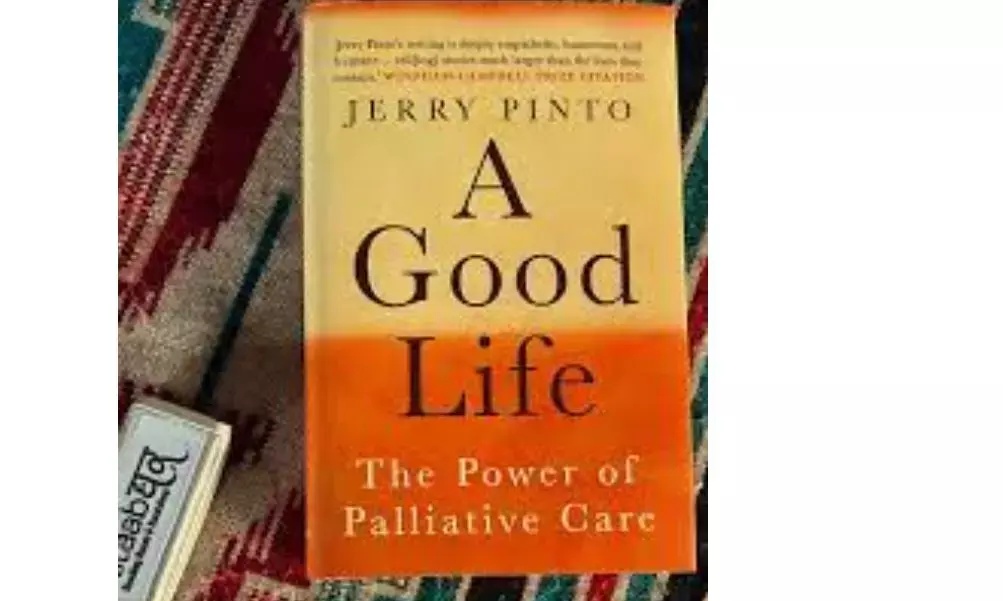
In ‘The Good Life’, Pinto has extensively interviewed doctors, nurses, occupational- and physio-therapists, social workers, patients, caregivers, dying children and their parents, from Tamil Nadu to Telangana, Goa to Assam, Delhi to Gujarat, Karnataka, visited homes, hospitals, wards and noted his experiences in fine prose.
He has quoted so many people, and those quotes are thought provoking:
‘In medicine, traditionally, the focus most of the time is on cure. A person has a ‘disease’ that needs to be diagnosed, and this must be ‘cured’. Not being able to do so is considered as a ‘failure’. Interventions like surgery, radiation, chemotherapy, medications, etc. are given primacy. Palliative care is transformative because it centres the human experience in all its complexity….. For families, it offers a space where grief, love and meaning can coexist, allowing them to face their challenges with more support and understanding.’
‘Doctors see it as their moral responsibility to fight for the patient until the last breath. It’s not easy, but that mindset has to change. The death of a patient is not a failure. Death is inevitable; it is what happens to all those who have been given the gift of life. We must train the younger generation to accept this, and to help our patients die a good death, in peace, made as comfortable as possible and with their loved ones around them.’
‘We are a country that believes deeply in magic and lives in the hope of miracles. The families of patients will say to a doctor, “Yes, the textbooks say that this is incurable, but anything is possible, no, doctor?” They will tell you how someone’s friend’s cousin recovered and lived for ten years when the doctors gave him two months. Finally, the doctor will say, “Yes, I suppose anything can happen,” and the family hears this as “Yes, a miracle is on its way.”’
Nurses, social workers, patients, their families, the bereaved, volunteers, neighbours, relatives, many are involved.
The lack of access to morphine or its derivatives, the despair of poverty, the longing to live, the inclusion of palliative care in the MBBS syllabus, all are topics lay people should be aware of.
Indian families don’t often like a patient being told about his/her condition. Patients themselves prefer to let their fathers, husbands, sons take decisions.
Financial constraints, the problems of very little children with very little lifespans, heartbreakingly demanding and complicated situations, all need many hands, often decades, to tide over.
That in recent years, palliative care has made its way into the MBBS syllabus is good news. Hopefully, it will become a way of caring in the remotest corners of India.
Hopefully, no other member of any family will have to suffer the way the recent two deaths in my family did.
A Good Life --- The Power of Palliative Care.
Author -Jerry Pinto.
Pages-257.
Publisher: Juggernaut Books, New Delhi, 2025.