

- >>
- Reports
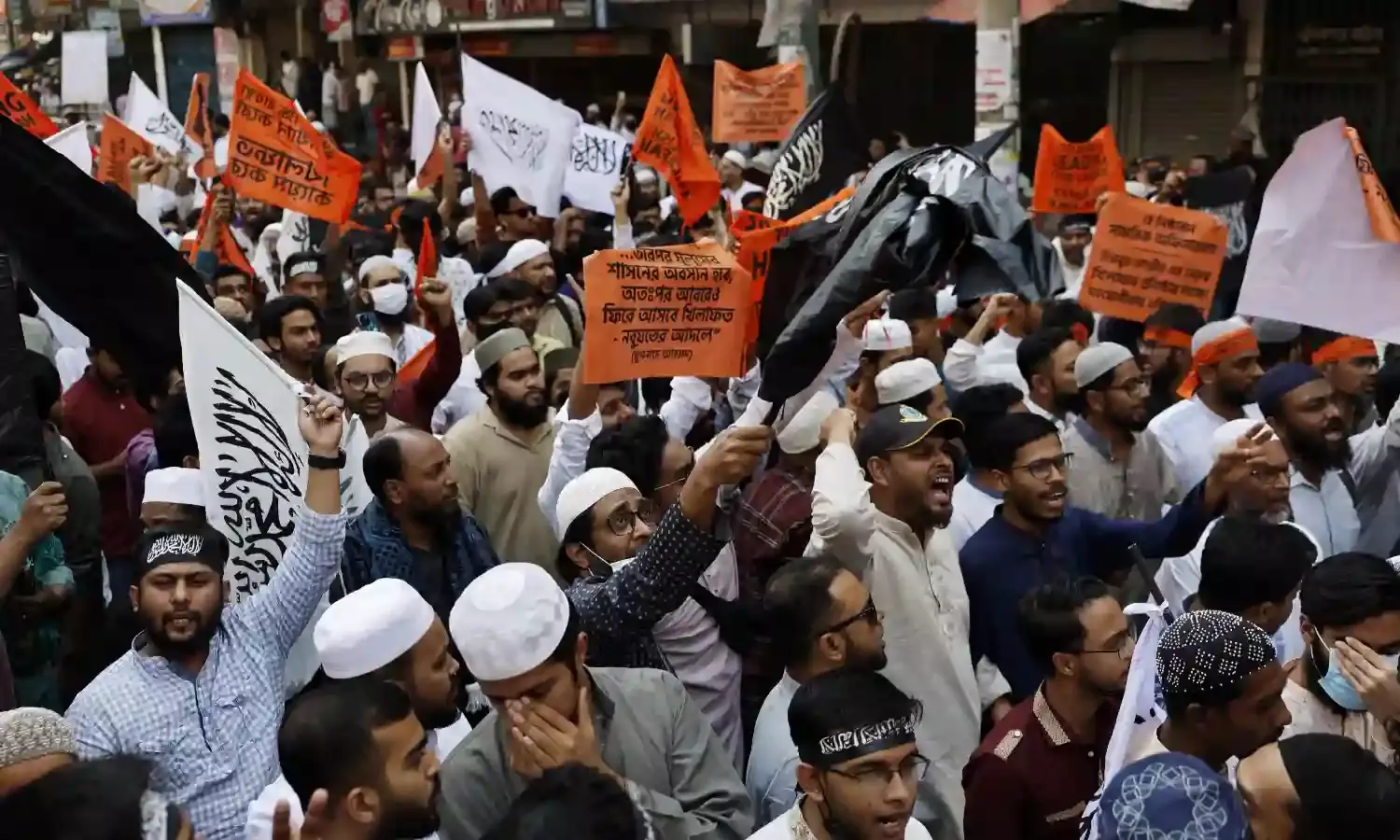
Islamism is filling a political vacuum in Bangladesh. The Jamaat-i-Islami has adopted Leftist slogans to widen its appeal in a situation where traditional political parties are in disarray and the Interim Government has failed to deliver on basics.
And their rallies are attracting huge crowds.
Despite having Nobel Laureate Dr.Muhammad Yunus to steer the ship of state for the past year, political uncertainty and administrative weakness mark post-Hasina Bangladesh.
The anarchic conditions prevailing there are proving to be conducive for the resurgence of religious extremism, says Iftekharul Bashar, Research Fellow at the International Centre for Political Violence and Terrorism Research (ICPVTR) in Singapore.
In a paper published by the S.RajaratnamSchool for International Studies in May, Bashar says; “The increasing influence of hard-line groups, the growing involvement of Bangladeshi youth in transnational extremist movements and the normalisation of extremist rhetoric, particularly online, are indicators of a deeper security concern.”
Between January and May 2025, the growth of hard-line groups and mob violence targeting public events dubbed “un-Islamic”, could beseen, Bashar says.
The interim government, led by Yunus, is facing leadership challenges, and is struggling to counter radicalisation. Over 5,800 weapons and 300,000 rounds of ammunition were looted from police stations in Bangladeshduring the “July 2024 Revolution” which overthrew Sheikh Hasina’s government. At least 70 militants were among the 2,200 jail escapees. Many of them are now active onlineselling the idea of setting up a Caliphate.
Among the 300 militants released after the revolution, were members of banned groups like Jama’atul Mujahideen Bangladesh (JMB) and the Ansarullah Bangla Team (ABT).Extremist groups like Al-Qaeda in the Indian Subcontinent (AQIS), the Islamic State of Khorasan (ISK) and local actors such as Hizbut-Tahrir (HT) have exploited the present disorder, spreading radical ideologies, targeting youth and inciting violence against minorities, Bashar points out.
While there have been no “terrorist attacks” as such, intimidation and display of militant symbols are in vogue. Islamist political groups like Hefazat-e-Islam Bangladesh (HIB), are advocating the implementation of Sharia laws, including the death penalty for blasphemy.The HIB held a massive rally in Dhaka on May 3 which was described as one of their largest public shows in years.
In April, a theatre performance of ShesherKobita, a famous novel by Rabindranath Tagore, in Dhaka, was cancelled after an Islamist vigilante group, Tawhidi Janata,issued threats. On May 19, in Madhupur, in Tangail, a folk festival honouring Lalon, a well-known Bengali mystic-musician, was cancelled after HIB said Lalon’s beliefs were against Islam.
During Ramadan this year, “moral policing” of women was carried out by supporters of groups like Islami Andolon Bangladesh and Bangladesh Jamaat-e-Islami. Despite a public outcry, police failed to take firm action against the culprits.
In a rally in Dhaka on April 7 to condemn Israel, Islamic State (IS) flags and a portrait of Osama bin Laden were prominently displayed.“While the public display of terrorist symbols by some protesters does not signify widespread national acceptance of extremist narratives, it risks normalising these ideologies and making them more accessible to a wider audience, “ Bashar warns.
There is a marked collaboration between traditional religious figures and mainstream educated hardliners, the latter using modern communication methods to spread radical thought. They use academic credentials and emotional global issues – such as the Palestine conflict – to sell violent ideologies as moral imperatives, the researcher points out.
An investigative report published by Bangladeshi digital outlet “The Dissent” on May 15, revealed that several Bangladeshi youths have joined the Pakistan Taliban (TTP)and are actively engaged in militant activities along the Pakistan-Afghanistan border. Some had been killed in battle
Traditionally, Islamic parties had got less than 10 percent of the vote in elections. But they are now trying to expand their base by adding to their agenda leftist and attractive secular goals, points out Shafi MohammadMostafa in The Diplomat.
The Hizb ut-Tahrir Bangladesh (HTB), banned since 2009, is rapidly regaining influence exploiting grievances such as high unemployment. While it originally concentrated on recruiting university students, it has since broadened its focus to include high school and junior college students.
The Jamaat-e-Islami leader, Shafiqur Rahman,said last week; “In the past, our struggle was against fascism and we won that battle. Now, in the Bangladesh of tomorrow, there will be in another battle — against corruption,” he told huge rally in Dhaka.
“We promise that if Jamaat comes to power, we will ensure the rights of farmers and workers,” he added.
Rahman stressed that if his party forms the government, its leaders would serve the people as servants, not rulers, “They will not accept government plots, ride duty-free vehicles, or directly handle public funds.”
The rise of Islamic parties is accelerated by their ability to engage with grassroots communities, spanning from urban centres to rural areas, through the promotion of preachers, social welfare initiatives, educational support and disaster relief efforts. With mainstream parties failing to meet public needs and sentiments, Islamic parties are emerging as alternatives, combining religious values with social services to strengthen their appeal and expand their influence.
When police went on strike on 6 August 2024, Islamic parties were among the groups that helped to protect minority-owned properties and places of worship. Their active role in maintaining order during this crisis underscored their growing influence in the country’s socio-political landscape.
The recent Jamaat-organized rally in Dhakasaw the attendance of leaders of several other parties and organisations, including the National Citizens Party, Islami AndolanBangladesh, Gono Odhikar Parishad, KhelafatMajlis, and Hefazat-e-Islam joined the Jamaat rally.
All emphasized the need to forge Islamic unity. Bangladesh has about a hundred Islamic parties and groups.
Writing in “East Asia Forum”” Molla Mehdi Hasan, recalls that Islamic parties have historically played a role in Bangladesh’s politics, particularly during the mass uprising against Gen. H.M.Enshad’s government in 1990. The Jamaat was part of the Bangladesh Nationalist Party (BNP)-led governments in 1991 and 2001. It was due to the influence of the Islamic parties, that Islamic rhetoric became mainstream in Bangladesh.
But Islamic unity is not easy to bring about. Theological differences, such as the one between Wahabbis and the Sufi-influenced practices popular among many Bangladeshi Muslims, divide Muslims.
The Jamaat’s controversial past, particularly its ties with Pakistan during Bangladesh’s Liberation War in 1971, remains a deeply divisive issue.
If the Islamic parties form a cohesive coalition, address theological differences and gain electoral success, Bangladesh’s political future is bound to undergo a sea change.
But the rise of political Islam in Bangladesh will lead to the erosion of religious and cultural freedoms. Incidents such as the cancellation of women’s football matches, threats against music festivals, and attacks on shrines and Sufi centres might become routine.
Bangladesh is expected to have general elections in early 2026. The electoral field now has the Bangladesh Nationalist Party (founded by freedom fighter and former President General Ziaur Rahman), the Jatiyo Party founded by former President Gen. H.M.Ershad, the National Citizens Party (NCP) a students’ organization which spearheaded the movement against Sheikh Hasina in 2024, the Communist Party, Islamic parties, and a number of others. Sheikh Hasina’s Awami League is not in the field as it was banned after the July 2024 revolution.
These parties have clashing ideologies and political programmes. For example, their views on Islamism varies. Some like the Jamaat want proportional representation, while the BNP is against it. The NCP, like the Jamaat, does not want any system which will lead to concentration of power.
All parties support the ban on Awami League. But hard core Awami League supporters have gone underground and are likely to emerge as an anarchic group as they did in Gopalgunjlast week when they brutally attacked an NCP rally. Seven people were killed in police firing. And the bodies were buried or cremated without an inquest, in grim reminder of past human rights violations by the State.
The Interim Government of Dr.Yunus which is to hold the fort till the general elections, has the challenging task of seeing that the liberal and secular legacy of the Bengalis’ freedom struggle and the Liberation War of 1971, is not swept away by the rise of illiberal forces.