

- >>
- Reports
When humans and animals compete for resources within a limited and shared space, human-wildlife conflict turns acute, resulting in losses on both sides. Climate change is also responsible for this, as it leads to the scarcity of resources.
Climate change affects forest cover, impacts landscapes and creates water shortage, especially in areas where there are extreme temperature conditions. Weather events such as erratic rainfall patterns, cyclones and dry spells impact the feeding pattern of animals, especially carnivores.
For instance, in case of long dry spells, animals venture outside forest in search of water. This leads to conflict with humans who reside in settlements in forest fringes around protected areas.
Though human-wildlife conflict exacerbated by climate change impacts both men and women, it makes the latter vulnerable as a social group. It has been observed that in certain geographies women are more vulnerable to attacks by wild animals as compared to men.
Besides a changing climate, the vulnerability to wildlife attacks also depends on cultural practices which determine occupation. For instance, in many places of India known for human-leopard conflict, women venture outside homes for collection of fuelwood and fodder.
At such times, they are more prone to attacks. Sometimes, shortage of water and natural resources mean that women have to travel long distances. This increases their fear of encountering wild animals in the way.
In India, where the interface between forests and rural inhabitations is a continuum, the leopard has adapted to live in the fringes of human habitations, says a study, Understanding drivers of human-leopard conflicts in the Indian Himalayan region: Spatio-temporal patterns of conflicts and perception of local communities towards conserving large carnivores. It was published in 2018 in the journal, PLOS One.
In Uttarakhand’s Pauri Garhwal district, human-leopard conflict is intense. When people are mostly engaged in farm work and firewood collection, attacks take place. Sometimes, they happen while they are on their way home from work.
In Uttarakhand, 62 people died due to leopard attacks from 2022 to June 2025. During the same period, 378 people were injured. According to media reports, almost 50 percent of attacks happen to rural women when they work outside.
“Since the last decade, there has been large-scale human outmigration from the mountainous region to the plains due to lack of sustained livelihood resources. Pauri Garhwal reported an annual growth rate of -0.13 with 122 villages abandoned completely between 2001–2011.
“Thus, present day Pauri Garhwal, is a matrix of agricultural lands, villages/towns, scrub/secondary forests and mature forests which is best suited for leopards,” the PLOS One study says. It adds that fifty-two percent of the victims killed by leopards were males and the rest females during 2000-2016, the study period.
In another geography too, women are exposed to leopard attacks due to the nature of their work. India’s tea estates were developed during the colonial period. As it is a precious commodity, there is an organised system of plucking and transportation. In the tea gardens of West Bengal, leopards have been known to attack and injure women when they are engaged in plucking tea leaves.
Data shows a total of 178 attacks from 2009-2018 in the Gorumara division of North Bengal which falls in Jalpaiguri district. A graph shared by researcher Aritra KShettry shows that activities like tea plucking and resource collection, which entail daily visits to the forest, made women more vulnerable to attacks than men.
In the tea gardens of North Bengal, human-leopard conflict is a reality. Here, leopards use the gardens for cover. Shifting weather patterns appear to be altering their movement. The study, Leopard in a tea-cup: A study of leopard habitat-use and human-leopard interactions in north-eastern India, says that most attacks occurred between 10am and 2pm when tea workers were active in the fields.
Though the victims were mostly men, women engaged in tea plucking were also vulnerable, with 20 percent of attacks occurring during this activity. The study finds that leopards occupied 68 percent of the study area, with their presence highest in tea gardens with dense ground vegetation.
In Western India, there are an estimated 1200-1300 leopards in Rajasthan. In the past 15 years, 30-35 humans have been killed by leopards across Alwar, Rajsamand, Dungarpur and Pratapgarh districts, says a report by Dharmendra Khandal for Tiger Watch. To mitigate human-leopard conflict and to conserve leopards, Rajasthan launched Project Leopard a few years back.
In Rajsamand, the human-leopard conflict is high. Many animals either reside in farmlands or inhabit hillocks and patchy forests. When the animals enter villages, encounters take place. On receiving information from people, the forest department sends rescue teams.
In the district, leopards have been spotted in fodder fields meant for cattle. In intense summers, leopards take shelter in these fields to cool off. As Rajsamand has marble mines, leopards stay and give birth to cubs in abandoned mines.
Another place in Rajasthan, the Zawar mines area, about 40 km from Udaipur, is also known for human-leopard conflict. This had led to discussions in women’s self-help groups, says Indira Meena, an inhabitant of Paduna village in Udaipur. She says rural women go out to gather firewood which makes them vulnerable to attacks by leopards.
Talks which happen in the women’s self-help groups (SHGs) reach the federation which heads them. “When forest guards come, we request them to catch the animals for release elsewhere. A woman, who works with me on SHGs, once saw a leopard. After she shouted, the animal left the place.”
Rajkaran Yadav, who runs non-profit Hanuman Van Vikas Samiti in the Karget area of Udaipur, says discussions happen with forest department officials, but the animals come back even after being caged and released. “Water is drying up in the forests, especially in summers. At that time, leopards come for food in the form of livestock and water in the villages.”
Digvijay Chauhan, a forest guard who was once posted in Udaipur, says that many villages dominated by the Gameti tribe face this problem. The habitat has changed because of mines and development projects. So, the animals sometimes enter human areas. Udaipur has over 100 leopards.
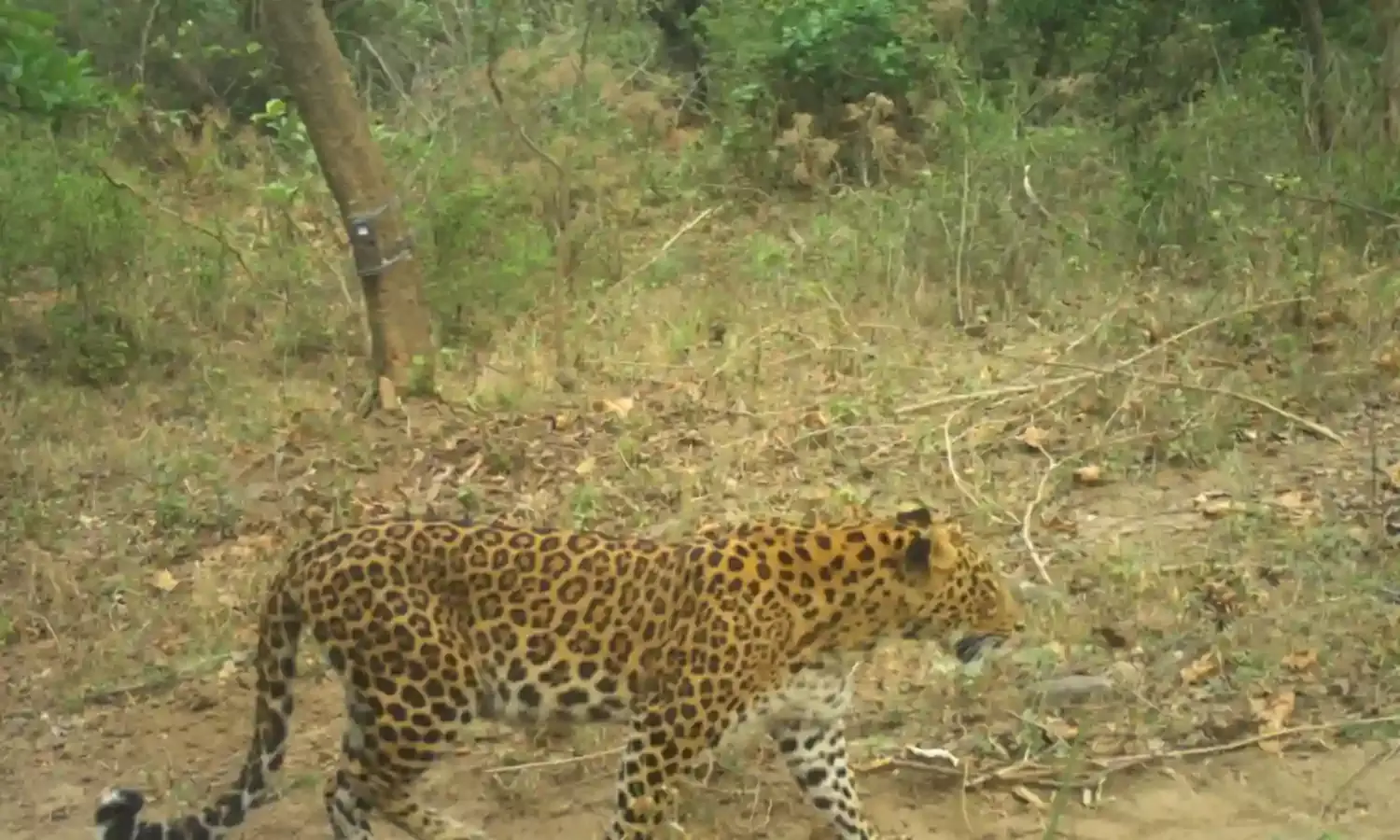
Cover Photograph: In India, where the interface between forests and rural inhabitations is a continuum, the leopard has adapted to live close to human settlements.
Second Photograph: Besides Uttarakhand, female tea pluckers in North Bengal are exposed to leopard attacks due to the nature of their work.