

- >>
- OPINION
The Delhi Forum for Strategic Studies (DFSS), held its annual conclave on January 17, 2026, in New Delhi. With the theme ‘India’s Neighbourhood and the Evolving Security Paradigm’, India’s ‘Neighbourhood First’ policy was critically examined.
The message was unambiguously clear that the government needs strategic recalibration, since goodwill alone no longer guarantees influence in our immediate periphery.
The failings of India’s ‘Neighbourhood First’ policy is more than apparent. Pakistan’s continued export of terror (with American and Chinese backing), Nepal and Bangladesh in the Chinese camp, US and Chinese involvement in Nepal and the CIA-orchestrated anti-India radical-Islamist regime in Bangladesh are only a few examples.
While a Chinese delegation, on invitation, visited the BJP and RSS headquarters in Delhi, Beijing announced that Shaksgam Valley is an integral part of China. And now China’s ambassador to Bangladesh Yao Wen recently visited an area close to the Siliguri Corridor in Northern Bangladesh – only the naïve would believe his visit was purely related to the Teesta Master Plan (TMP).
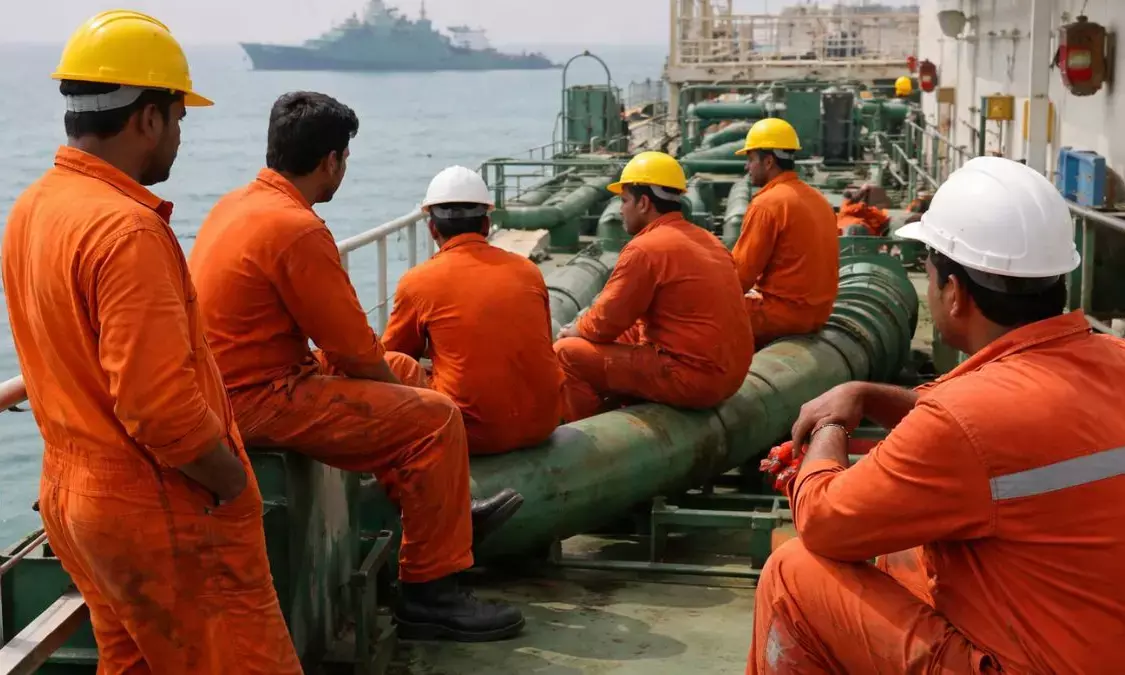
Sixteen Indian sailors detained after the oil tanker MT Valiant Roar was intercepted by the IRGC (Islamic Revolutionary Guard Corps a powerful entity in Iran) on December 8, 2025, continue to be in Iranian custody.
Families of the sailors have moved the Delhi High Court. India stopped importing Iranian oil during the first United States presidency of Donald Trump and has now reportedly given up operational control of the Shahid Beheshti terminal of Chabahar Port fearing Trump’s tariffs/sanctions.
The Shias in Kargil and elsewhere in India have been calling for India to support Iran but American pressure appears all pervasive.
In such a geopolitical setting, foreign minister S Jaishankar asking his Polish counterpart not to support Pakistan is not likely to make any difference, given the current status of US-Poland-Pakistan relations. It is somewhat akin to asking China not to support Pakistan militarily.
Despite the 16 Indian sailors being in Iranian custody since December 8, 2025, they have reportedly no consular access to India. This in itself indicates the state of India-Iran relations.
For that matter, while the government insists that Pakistan repeatedly asked for a ceasefire during Operation ‘Sindoor’, India failed to insist that Pakistan first release former Indian Navy officer Kulbhushan Yadav jailed in Pakistan since 2015.
Prime Minister Narendra Modi broke protocol to personally receive Emir Tamim bin Hamad bin Khalifa Al Thani at the airport when he visited India in February 2025, but former Indian Navy officer Purendu Tiwary continues to rot in a Qatari prison.
MEA spokesperson Randhir Jaiswal (called Sleepy Joe in the social media) has reportedly said that a UAE firm has been asked for legal help to obtain the release of the Indian sailors detained in Iran.
The UAE appears to be the limit of India’s influence in the Middle East. That’s why the Prime Minister wrote to the UAE to lift the ban on the movie ‘Dhurandhar’, although the movie was banned in six Gulf countries - Bahrain, Kuwait, Oman, Qatar, Saudi Arabia, and the UAE. It is not clear why Jaishankar could not sort out such an issue at his level.
Donald Trump’s actions have caused upheaval in the Middle East: the Saudi Arabia-Pakistan Defence Agreement (SPDA) – the reportedly CIA-Mossad instigated protests in Iran that has burned down over 50 mosques; the US-Israel threat to attack Iran; rejuvenation of Al Qaeda in Turkey in collaboration with Syria under US oversight, and many such.
But the UAE’s readiness to allow the US to attack Iran and its closeness to Tel Aviv has rendered it a Jonah among Muslim nations of the Middle East. To top this, UAE’s clash with the Kingdom of Saudi Arabia (KSA) in Yemen has created a sense of insecurity.
Little wonder Sheikh Mohamed bin Zayed Al Nahyan, President of the UAE, recently travelled six hours (Abu Dhabi to New and back) for a 1 hour 45 minutes meeting with PM Modi on January 19, 2026. Among the various cooperative issues discussed, including establishing 'Digital Embassies' between the UAE and India, both leaders welcomed the signing of Letter of Intent towards the conclusion of a ‘Strategic Defence Partnership’. India and UAE also signed a USD3 billion LNG deal – will the payment be in dollars?
There is speculation that UAE wants India’s support to mend relations with Saudi Arabia and may be looking for air defence systems from India. But this can be managed better by the US since both are allied with America.
On May 15, 2025, the US and UAE signed an AI agreement supporting the USD 1.4 trillion investment commitment secured by the US in March 2025.
The UAE hosts about 5,000 US military personnel across three key facilities: Al Dhafra Air Base, Jebel Ali Port; Fujairah Naval Base. The US operates F-15, F-22, F-35, Global Hawks, AWACS, and KC-10 tankers from the Al Dhafra Air Base.
The UAE operates US-made THAAD and long-range Patriot systems, alongside a version of the Israeli-made Barak air defence system.
For medium-range threats, the UAE relies on the South Korean Cheongung II. But yes, the UAE would be interested in Indian AD systems, other weaponry and defence cooperation, especially in the aftermath of Operation ‘Sindoor’
Finally, India’s focus should not deviate from getting the 16 sailors released from Iran at the earliest. Iran’s foreign minister Seyed Abbasi Araghchi was scheduled to visit India in mid January 2026 for the 75th anniversary of diplomatic ties, but his trip was called off due to escalating protests in Iran.
Jaishankar, however, reportedly spoke to Araghchi on the telephone. Whether he raised the issue of the 16 sailors is not known, but Iran continues to deny consular access to India for over six weeks and this should raise serious concern.
Cover Photograph- representational image.
Lt General Prakash Katoch is a veteran from the Indian Army. The views expressed here are the writer’s own.