

- >>
- OPINION
Old Schoolboys On The Battlefield
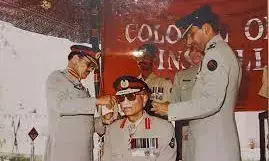
This narrative spans two India- Pakistan wars and is centered around one person, KK Afridi of the Pakistani Army. Afridi’s long lineage went back to Adam Khel Afridi tribesmen inhabiting hills between Peshawar and Kohat of Pakistan.
Khushdil Khan (KK) Afridi was born on 10 January 1929. He studied at Islamia School Kohat and Islamia College Peshawar. He joined 4th Pakistan Military Academy (PMA) Kakul Long Course after pre-cadet course training at Quetta. In the Academy, he held the Battalion Senior Under Officer appointment and had won the coveted sword of honor. He joined 5th Battalion of 13th Frontier Force Rifles (later designated 10 Frontier Force Regiment) on commission in 1951.
In 1956, Afridi transferred to 8 Frontier Force Regiment. In 1957, he was posted as GSO-3 of the military liaison office in Pakistan High Commission in London, where he spent three years. Afridi attended the 1962 Staff College course and on completion was appointed instructor at School of Infantry & Tactics at Quetta.
In the spring of 1965, he was a company commander of 8 FF. The Unit was part of 51 Brigade commanded by Brigadier (later Lieutenant General) K. M. Azhar Khan operating in Rann of Kutch area.
The opposing Indian brigade was commanded initially by Lt. Colonel (later Chief of Army Staff) K. Sunderji who was officiating Brigade Commander and later by Brigadier Pahlajani and consisted of 2 Sikh Light Infantry (SLI) commanded by Lieutenant Colonel Henry Haus, 1 Mahar Regiment commanded by Lt. Colonel K. Sunderji and 11 Field Regiment Artillery commanded by Lieutenant Colonel ‘Henry’ Srinavasan.
Afridi took a patrol of thirteen men for reconnaissance of Indian forward positions. The team wandered into a minefield, killing all except three. Severely wounded, Afridi lying in the minefield gave his weapon and watch to the Junior Commissioned Officer (JCO) and ordered him to go back.
The JCO did not expect Afridi to survive, so he reported that he had been killed, and an absence prayer funeral was held for him. Afridi landed on his right side in the minefield with injuries to head, right hip, and loss of two fingers of right hand. He was profusely bleeding and in and out of consciousness. Major R.K. Bali (2 Sikh Light Infantry) extricated Afridi from the minefield, and he was evacuated by helicopter to Command Hospital (CH) Pune
Once, during transfer at a local train station, one gentleman crossed the escort cordon and asked Afridi if he was from Kohat. A surprised Afridi answered yes but did not recognize the person, who responded that he was Major Parshotam Lal Batra from Kohat. Afridi now recalled that Batra was in the same grade in school but studying at Hindu Sanatan Dharam Bharti high school of Kohat.
In primary school, Hindus and Muslims studied together but they had separate high schools. Batra was a good hockey player, and Afridi had seen him at inter-school hockey games. During the matric examination, both were sitting next to each other in the examination hall.
A jubilant Batra asked if he could bring his wife to meet him at the hospital, followed by his daughter and son on another occasion. It was a strange meeting of old school boys in extraordinary circumstances.
Afridi was treated very well, and he maintains that if he had been evacuated to Pakistan, he may not have survived. After recovery, he was flown to Delhi and then repatriated on 14 August 1965.
Major KK Afridi with his father and elder daughter Sabrina after repatriation August 1965
Second Lieutenant Hariharan who was serving as intelligence officer of 11 Field Regiment was present during initial interrogation of Afridi. He has stated that Afridi refused to give any details except his name, number, and rank.
Afridi was appointed GSO-II at the Military Operations directorate. After commanding 18 FF (1967-68), he was appointed instructor at Command & Staff College Quetta. In the spring of 1971, he was given the command of 12 FF to take the battalion to East Pakistan. He was promoted to Colonel rank and appointed Colonel Staff of 9 Division, commanded by Major General Shaukat Raza, followed by Major General H.M. Ansari.
After the surrender of the East Pakistan garrison, Afridi was a prisoner at the Ramgarh Prisoner of War (POW) camp. This was his second captivity, in two successive India-Pakistan wars. He had an interesting encounter with Major General Shabeg Singh (Garhwal Rifles & Gurkha Rifles) then serving as General Officer Commanding (GOC) of Madhya Pradesh, Bihar, and Orissa) Area. Shabeg was later dismissed from service and had joined Bhindrawale.
Afridi was among the last batch of POWs to be repatriated in 1974. His wife had been extremely ill and passed away only two weeks after his repatriation from India. Family members claim that she was only waiting for the Colonel to return before leaving this world.
After his return from captivity, he was among the handful of Colonels promoted to Brigadier rank and commanded 102 Brigade in Peshawar. In 1976, he was promoted to Major General rank and commanded 14 Division (1976-78) and 19 Division (1978-82).
In 1982, he was promoted to lieutenant general rank and appointed Corps Commander of Quetta based XII Corps. After the Baluchistan Governor, Lieutenant General ® F. S. Lodhi’s aircraft crashed killing pilot and governor’s ADC and injuring Lodi, Afridi was appointed acting governor of the province.
President and Chief of Army Staff General Muhammad Zia ul Haq held a conference on the Islamization programme that was attended by governors, senior government officials and leading clerics. Only Afridi and Governor of then NWFP Lieutenant General Fazl-e-Haq disagreed with Zia’s programme.
The old soldier faded away after retirement into a quiet and long retired life and was still going strong at the age of ninety-six. Military service continued in the second generation, and his son Lieutenant Colonel Saleem Afridi served with 10 FF and his nephew and son-in-law Captain Aizaz Rahman served with 18 FF before transferring to civil service.
A life of chivalry and luck well lived!
Acknowledgement: Author thanks his friend Hamid Hussain in USA, who had given his permission to publish this piece. He is a store house of information pertaining to the British Indian Army and the Pakistan Army.
Lt General VIJAY OBEROI is a former Vice Chief of the Indian Army and currently Director Emeritus of Centre for Land Warfare (CLAWS). The views expressed here are the writer’s own.