

- >>
- OPINION
America’s Pakistan Fixation
Another $686 million approved for Pakistan’s F-16 fleet
The US Defence Security Agency (DSCA) has approved $686 million for advanced technology upgrades for Pakistan’s F-16 fleet. It included a new 500-pound bomb, Link16 advanced secure data communication, precision navigation systems, cryptographic equipment, avionic upgrades and logistics.
This is the second upgrade post Operation Sindoor after the key airfields of Pakistan were crippled. These will not only extend the life of F-16 till 20240 but also arm it with cutting-edge technology.
This pattern does not reveal anything new; it simply confirms what South Asia has watched for decades.
The U.S. keeps returning to the same playbook, arming a state that destabilises its own neighbourhood, indulges in duplicity as a policy tool, and leans ever deeper into China’s strategic embrace. What changes are the administrations in Washington; what never changes is the reflex that Pakistan remains “useful.”
The result is predictable: Pakistan gets hardware to maintain the illusion of parity, India gets another reminder that Washington’s instincts haven’t fully evolved, and the region absorbs the turbulence.
The origins of this relationship go back to a Cold War bargain masquerading as strategy. Pakistan offered geography and pliability; the U.S. offered money, training, and aircraft. It wasn’t an alliance so much as a rental agreement dressed up in grand language. Through the 1980s and 1990s, the F-16 became a symbol of that transaction.
Islamabad treated it as proof of American backing; Washington treated it as leverage. Even after 9/11, when Pakistan’s double games became impossible to hide, the flow of support did not fully halt. Every U.S. administration convinced itself that Pakistan could still be “managed,” even as Pakistan perfected the art of extracting benefits while undermining the very agendas the U.S. claimed to pursue.
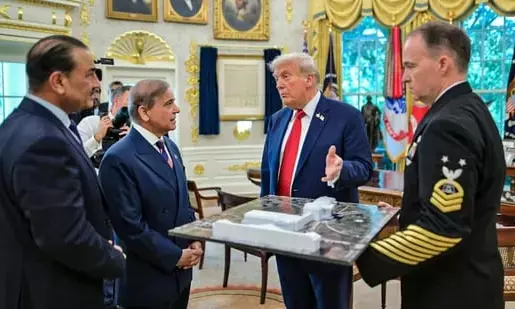
In 2025, the same pattern continues with renewed swagger. Pakistan’s military establishment won Trump’s confidence through methodical influence rather than coercive drama. Asim Munir, long positioned as Pakistan’s central decision-maker, oversaw a deliberate outreach campaign in Washington that relied on personal networks close to Trump, sycophancy, and packaged economic pitches involving rare-earth potential and financial partnerships.
The turning point came when Trump hosted Munir for a private White House lunch, a gesture that signalled a willingness to engage directly with the army’s leadership despite earlier public accusations that Pakistan had misled the United States on counterterrorism. Trump’s shift created space for the generals to reinforce their primacy at home while strengthening a military structure that already dominates national security, foreign policy, and strategic assets in a fragile nuclear state.
Consider the first idea: that the F-16 fleet gives Washington leverage over Rawalpindi. History has long disproved this. Pakistan has repeatedly used American-origin platforms in ways that violate end-use assurances, including during the Operation Sindoor with India.
The second argument, that Pakistan is key to counter-terrorism, has collapsed under the weight of Pakistan’s own actions. The groups that threaten regional security did not grow despite the Pakistani state; many grew because the state fed them, funded them, or looked away.
The third argument is the most revealing: the U.S. wants India to counter China, but not so strongly that India becomes fully independent of American strategic influence. Arming Pakistan becomes a way to keep India in a controlled orbit.
This logic might have made sense thirty years ago. It does not today. Pakistan is no longer a U.S.-dependent state; it is a Chinese military client. Its economy runs on loans from Beijing and Riyadh, its infrastructure is mortgaged to the Belt and Road, and its military modernisation increasingly relies on Chinese platforms.
Turkey empowers its defence drone ecosystem. When the U.S. upgrades Pakistan’s F-16 fleet, it is essentially refreshing the last Western link in a military that now operates within China’s strategic umbrella. Beijing benefits every time Washington foots that bill.
The impact on India is less about tactical risk and more about strategic clarity. The F-16 upgrades themselves do not alter the military balance. India’s aerospace environment has moved into a different league, with Rafales, Tejas Mk-1A, S-400 coverage, and deeper integration of sensors and standoff weapons. The imbalance in potential is widening, not narrowing.
For New Delhi, the political message is clear: Washington wants India to be an ally against China but gives priority to its leverage with Pakistan. A revisit of the Seventh Fleet mentality of 1971. India is witnessing a superpower that is preaching about a free and stable Indo-Pacific, yet continues to provide a state that will add no value to liberty or tranquillity.
This cultivates a lack of trust, which has cast its ominous cloud over the India-U.S. relationship over the years. President Trump's tariff weaponisation has further antagonised India. New Delhi has entered into the basis agreements, intensified cooperation in intelligence, and integrated defence technology packs with the US.
But still, Washington acts like Pakistan is a hedge that is needed, even when Pakistan is dependent militarily on China, politically unstable and increasingly less significant to the balance of power in Asia. India realises that the U.S. and Pakistan will never achieve complete decoupling, yet with each significant upgrade comes the thought that Washington has yet to come to terms with the geopolitical reality.
China is the quiet beneficiary of this muddled behaviour. Every American gesture toward Pakistan strengthens Beijing’s narrative that India should never place full trust in the West. China’s aim is simple: keep India sceptical, slow, and strategically cautious. A confident India is a direct obstacle to Chinese ambitions. An India distracted by the U.S.–Pakistan equation becomes more hesitant in the Indo-Pacific pushback.
For Pakistan, meanwhile, these upgrades feed a more dangerous illusion. The country is economically broken and strategically cornered, but America arms Pakistan without aiming. Instead of confronting its internal crises, Islamabad uses external aid to sustain its old doctrine of parity with India.
That delusion increases the risk of miscalculation. Washington claims these upgrades stabilise Pakistan; history shows they create room for reckless behaviour.
The bigger picture outlook is evident. The U.S. is attempting to maintain an influence it no longer has with instruments that no longer work, on a state whose geography is becoming irrelevant with its internal turmoil. Pakistan survives the crisis; America funds it.
India rises on stability; America occasionally complicates that rise. The contradictions are visible to everyone except the policymakers who remain trapped in Cold War muscle memory.
India’s response cannot be emotional or reactive. It must be structural. The first step is sharpening deterrent depth; more long-range precision fires, electronic warfare dominance, high-density air-defence grids, a drone defence eco system for mass precision warfare, and C5ISR networks that compress decision cycles.
Strength comes from redundancy, not platform glamour. The second step is shifting the regional balance in domains where Pakistan is most vulnerable, especially at sea. The coastline and maritime supply chains of Pakistan are weak; India’s expanding naval power provides it with a strategic advantage.
India must also ensure strategic autonomy by ensuring that its defence ecosystem is diversified. The US is a valuable high-technology ally, but it should not be dependent. French, Israeli, Russian, and indigenous inputs create a healthier mix.
Quiet diplomacy is equally essential. India wants to tell Washington, without theatrics, that American weapons in Pakistan do not strengthen regional stability; they complicate it. Washington listens when India speaks without noise.
Most importantly, India must treat Pakistan not as a central axis but as a manageable variable. The true strategic contest is with China. Pakistan is a distraction when treated as a peer competitor; it is a security problem when treated with discipline. New Delhi’s rise depends on avoiding the trap of letting Islamabad dictate the agenda.
To conclude, Pakistan survives on outside cash and its own internal drift, while India has become the only steady hand capable of shaping Asia’s security landscape. Persisting with aimless US support to Pakistan is not geopolitics but a poor strategy.
India, therefore, must chart its course on the expectation that Washington will play the Pakistan card to establish its regional presence. However, regional stability will rest on India’s own ascent and its ability to navigate around American inconsistency with a clear, self-defined compass.
Lt General A.B.Shivane retired from the Indian Army. The views expressed here are the writer’s own.