

- >>
- OPINION
Election fever has gripped Bangladesh with just a fortnight to go before February 12, when citizens will vote to decide who – and how – the country will be governed in the months and years ahead. As expected, the electoral scene is becoming more animated by the day. The absence of the Awami League, still the country’s largest political party, has opened the field to a range of possibilities that would have been unthinkable until recently.
While election outcomes can never be predicted with certainty, some informed assessment is possible by reading the prevailing political mood. The Bangladesh Nationalist Party (BNP), which was the second-largest party until the upheavals of July 2024, has emerged as the frontrunner. Yet the confidence with which observers only a few months ago predicted a BNP sweep is noticeably absent from recent commentary.
Even during the Awami League’s strongest years, the BNP managed – often against considerable odds – to retain its core support base. With the Awami League now out of the reckoning, the contest should, at least on paper, have tilted decisively in the BNP’s favour. Political observers, however, are far less certain, despite Tarique Rahman’s return to Bangladesh and his assumption of the party’s leadership role.
The principal reason for this uncertainty is the rise of the BNP’s former ally, the Jamaat-e-Islami (JeI). Capitalising on the student- and youth-led uprising of July 2024, the JeI has returned to mainstream politics after the interim government headed by Muhammad Yunus lifted the ban imposed earlier by the ousted Awami League government.
Even during the years it was formally banned, the JeI – particularly its student wing, the Islami Chhatra Shibir – remained active through clandestine networks. Over time, it expanded its influence to an extent that it can no longer be dismissed as a marginal or niche force. Today, the JeI represents organised political Islam in Bangladesh and poses a challenge to the BNP – not necessarily at the level of electoral arithmetic, but in shaping the post-election political landscape.
It is this reality that may have prompted the BNP to soften its position towards the JeI. Observers have noted that the idea of a National Unity Government – quietly floated, according to some journalistic accounts, by the same behind-the-scenes actors who played a role during the July 2024 unrest – is no longer rejected out of hand by the BNP. Instead, it has come to be acknowledged as a post-poll possibility.
At a recent event organised in Dhaka by the Centre for Policy Dialogue, BNP Secretary General Mirza Fakhrul Islam Alamgir stated that “if voted to power, the BNP would form a government of national unity and ensure representation from parties that participate in the polls as well as those who protested against the last autocratic regime.”
The JeI has publicly welcomed the idea of a unity government and is reported to be in discussions with multiple political parties on post-election cooperation. Its leadership has indicated a willingness to share power should political forces converge. Vernacular media reports suggest that the party sees an inclusive arrangement as desirable even if it were to secure only a plurality, pointing to preparatory thinking around a post-election compromise.
This emphasis on unity has found resonance in sections of the media. Editorials in both English- and Bangla-language dailies have turned “national unity” into a recurring refrain, with some commentators arguing that a broadly representative government may be necessary to ensure post-election stability.
It is in this context that a recent Washington Post report has drawn attention. The report referred to a closed-door meeting between American diplomats and some Bangladeshi journalists. According to a leaked audio cited by the paper, an unnamed U.S. diplomat remarked that Bangladesh had “shifted Islamic” and predicted that the Jamaat-e-Islami would “do better than it’s ever done before” in the election. The diplomat was also quoted as saying, “We want them to be our friends,” and suggested that journalists consider giving platforms to members of Jamaat’s student wing.
These remarks prompted criticism from several quarters. Many observers interpreted them as an instance of foreign interference in a sensitive electoral process. Political thinker Farhad Mazhar described the prospect of closer U.S.-Jamaat ties as a “warning sign,” viewing it with scepticism given Bangladesh’s recent political turbulence and longstanding concerns about external influence. Critics focused on two aspects of the diplomat’s comments: the apparent willingness to engage closely with a party burdened by a controversial past, and the suggestion that media outlets offer space to the Islami Chhatra Shibir, an organisation widely associated with political violence.
It is, of course, routine for diplomats to maintain contact with a wide spectrum of political actors, particularly in a country heading into elections. Foreign missions also routinely assess possible outcomes and signal readiness to engage with parties likely to shape a post-poll dispensation. Such contacts, by themselves, do not amount to interference, and are not unusual – even India engages in similar diplomatic outreach.
That argument weakens, however, when a diplomatic mission appears to advise journalists to provide space to a particular political party or its affiliates. Such a suggestion risks being seen as partial and could reasonably be interpreted as an attempt to influence public discourse during an election. The Bangladesh government’s silence following the Washington Post report suggests a preference to avoid escalating the issue.
The JeI, for its part, has responded with visible enthusiasm. Its leaders have already begun projecting the remarks as an endorsement, telling supporters that “even the U.S. is depending on the JeI to establish a corruption-free and equitable society in Bangladesh.” Whether this perception translates into votes remains uncertain, but it has undoubtedly provided a morale boost to a party whose proximity to Pakistan’s military establishment and documented role during the 1971 Liberation War continue to cast a long shadow.
In this context, memories of the “10-truck arms haul” of 2004, during the BNP-JeI government, inevitably resurface. The seizure of a massive cache of arms and ammunition near Chittagong raised serious questions about state complicity and regional security, particularly given allegations that the weapons were intended for insurgent groups operating in India’s Northeast. While several accused, including senior ministers, were convicted by a lower court, those verdicts were later overturned or modified by the High Court.
Ultimately, the February 12 election is not merely about who governs Bangladesh, but about the political direction the country chooses at a moment of regional churn. A post-poll arrangement bringing together the BNP, the Jamaat-e-Islami and other Islamist forces under the banner of national unity would inevitably revive questions for India relating to security, cross-border militancy and the durability of gains achieved over the past decade.
The outcome will therefore be watched as closely in New Delhi as in Dhaka, as Bangladesh stands at a crossroads where domestic politics and regional geopolitics intersect.
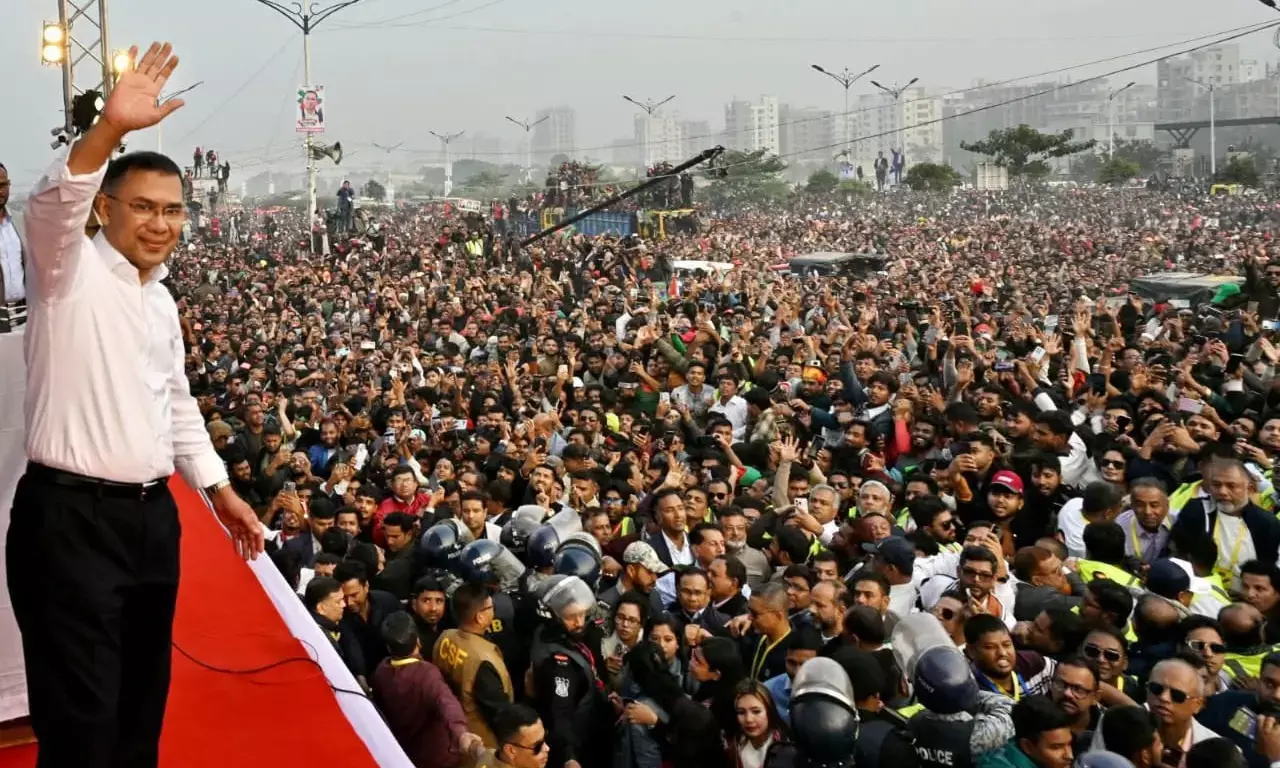
Cover Photograph: BNP Acting Chairperson Tarique Rahman campaigns for his party.
Sandip Mitra retired from the Indian Foreign Service. The views expressed here are the writer’s own.