

- >>
- OPINION
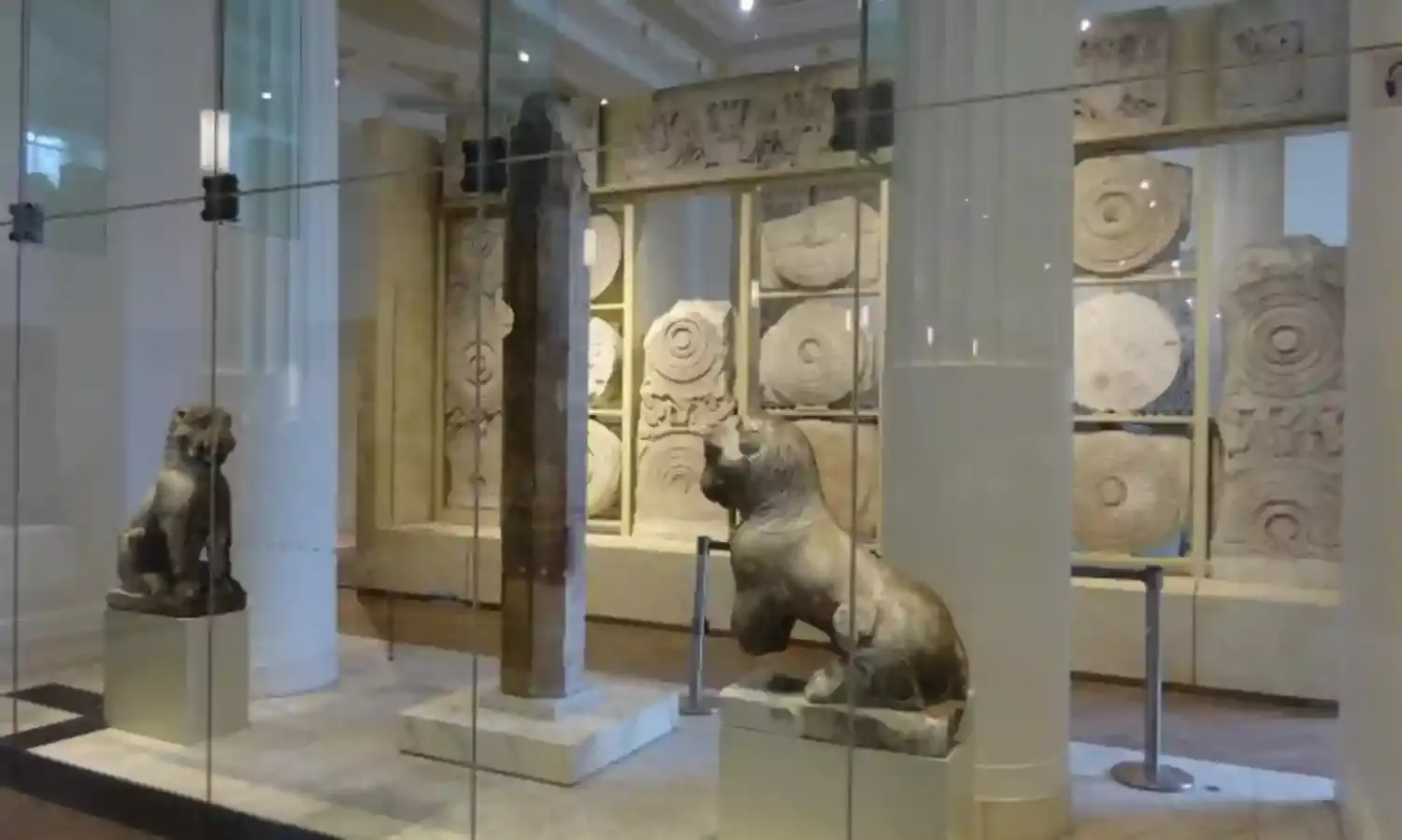
A darker truth lies behind a new exhibition unveiled in London by the British Museum. Visitors are ostensibly invited to admire Hindu, Buddhist, and Jain deities and participate in darshan—the act of seeing and being seen by the divine. But what they are really being shown is a carefully staged illusion made up of incense, soft lighting, and spiritual language disguising the brutal legacy of imperial plunder.
Thanks to a request under the UK Freedom of Information Act, the British Museum has confirmed that the budget for this exhibition—Ancient India: Living Traditions—was £839,000 (₹8.7 crore). The museum also disclosed that the exhibition includes 178 objects from its own South Asia collection, which totals over 38,000 artefacts, many taken during colonial rule. These items are mostly stored in Bloomsbury, central London, or at the British Museum’s ARC facility in Reading.
The museum currently employs 110 curators and project curators, earning an average salary of £39,508 (₹41 lakh). They are eligible to join the UK Civil Service Pension Scheme, which guarantees inflation-linked lifetime payouts and survivor benefits—benefits that, for long-serving employees, could be worth well over £1 million (₹10.6 crore) over a lifetime. On the security side, the museum disclosed it employs 307 full-time staff, at a combined annual cost of £12.7 million (₹134 crore).
At the heart of the new exhibition stand the Amaravati sculptures, sacred limestone reliefs from a 2,000-year-old Buddhist stupa in Andhra Pradesh. They were not gifted. They were seized in the 1840s by British colonial officer Sir Walter Elliot, who hacked them from a holy site and shipped them first to Madras, then to London—all before the 1857 uprising against British rule. What was left behind in India was desecration. What arrived in Britain became museum treasure. Now these relics are rebranded as reverent display. But for many, especially those in formerly colonised countries, it feels less like devotion and more like window shopping in a colonial pawnshop.
The museum’s former director, Neil MacGregor, famously described it as “a museum of the world, for the world,” and claimed “repatriation is yesterday’s question.” But this vision collapses under the weight of geography. A return airfare from Delhi to London costs over £900 (₹94,000). Add lodging and food, and “global access” begins to look like a luxury cruise. For most, the only “universal” thing about the British Museum is its branding.
Yet rather than reckon with this truth, the museum maintains possession as policy. The Amaravati sculptures remain locked behind Perspex. The Benin Bronzes—looted in 1897—remain in London. Ethiopian tabots, Ghanaian regalia, and stolen Greek and Cypriot statuary remain trapped in marble silence. What the museum calls shared heritage, many now see as the spoils of empire.
Not all institutions remain wedded to this colonial amnesia. In 2022, the Horniman Museum in south London returned a significant collection of Benin Bronzes after public consultation and negotiations with Nigerian officials. The gesture was modest in scale but monumental in spirit—a model of ethical clarity.
In 2023, Manchester Museum repatriated 174 artefacts to Australia’s Anindilyakwa community, including shell dolls, baskets, and ceremonial spears. The return was part of a three-year collaboration with the Anindilyakwa Land Council and AIATSIS, supported by UNESCO.
Even Oxford is stirring. The Pitt Rivers Museum is now actively discussing the return to India of 415 human remains, including more than 40 human skulls once displayed publicly until 2021. These relics were acquired during the British Raj and showcased as anthropological trophies. That even a famously opaque university collection is opening up, while the British Museum clings to conquest, shows just how far behind the institution has fallen.
The British Museum, by contrast, clings to 19th-century justifications. Its most senior curators enjoy taxpayer-backed pensions and increasingly flexible hours. Some work part-time or from home. Meanwhile, the museum receives more than £45 million (₹475 crore) a year in government subsidy. Its director earns £215,841 (₹2.3 crore)—more than a UK Cabinet Minister.
But instead of returning these priceless objects—or even reckoning honestly with their origins—the museum clings to possession as policy, locking them behind glass and calling it scholarship. This culture of denial is not confined to history. Recent scandals only reinforce the rot: a curator dismissed over the theft and online sale of more than 1,800 artefacts; an IT sabotage debacle that disrupted operations; and a devastating exposé in The New Yorker that stripped away the illusion of curatorial virtue.
Nor is this a modern phenomenon. In the 1970s, James A. Mackay, a curator in the museum’s philatelic department, was caught stealing valuable stamp proofs and exchanging them for others. He was fined, dismissed, and the episode triggered yet another review of museum security—proof that the institution’s blind spot on internal accountability spans generations.
Small wonder that some museum critics are now calling for a dramatic paring down of the estimated 1,000 full-time staff—or even partial privatisation of the institution—so that public money might serve the taxpayer more directly. A 25% reduction in staff could save over £12.5 million (₹130 crore) a year—enough to fund 357 primary care nurses, 312 state school teachers, or provide 25,000 children with free school meals for an entire year.
To walk through the British Museum today is not to commune with world culture. It is to walk through the wreckage of empire. The labels speak of craftsmanship and belief. The walls echo with conquest, silence, and institutional refusal. The curators call it heritage. But for millions across India, Nigeria, Greece, Ethiopia, and beyond, it is known for what it truly is: a chor bazar in marble and glass.
In plain English: a showroom of stolen goods.
Shyam Bhatia is a journalist, writer and war reporter. He is an author and a columnist. The views expressed here are the writer’s own.