

- >>
- OPINION
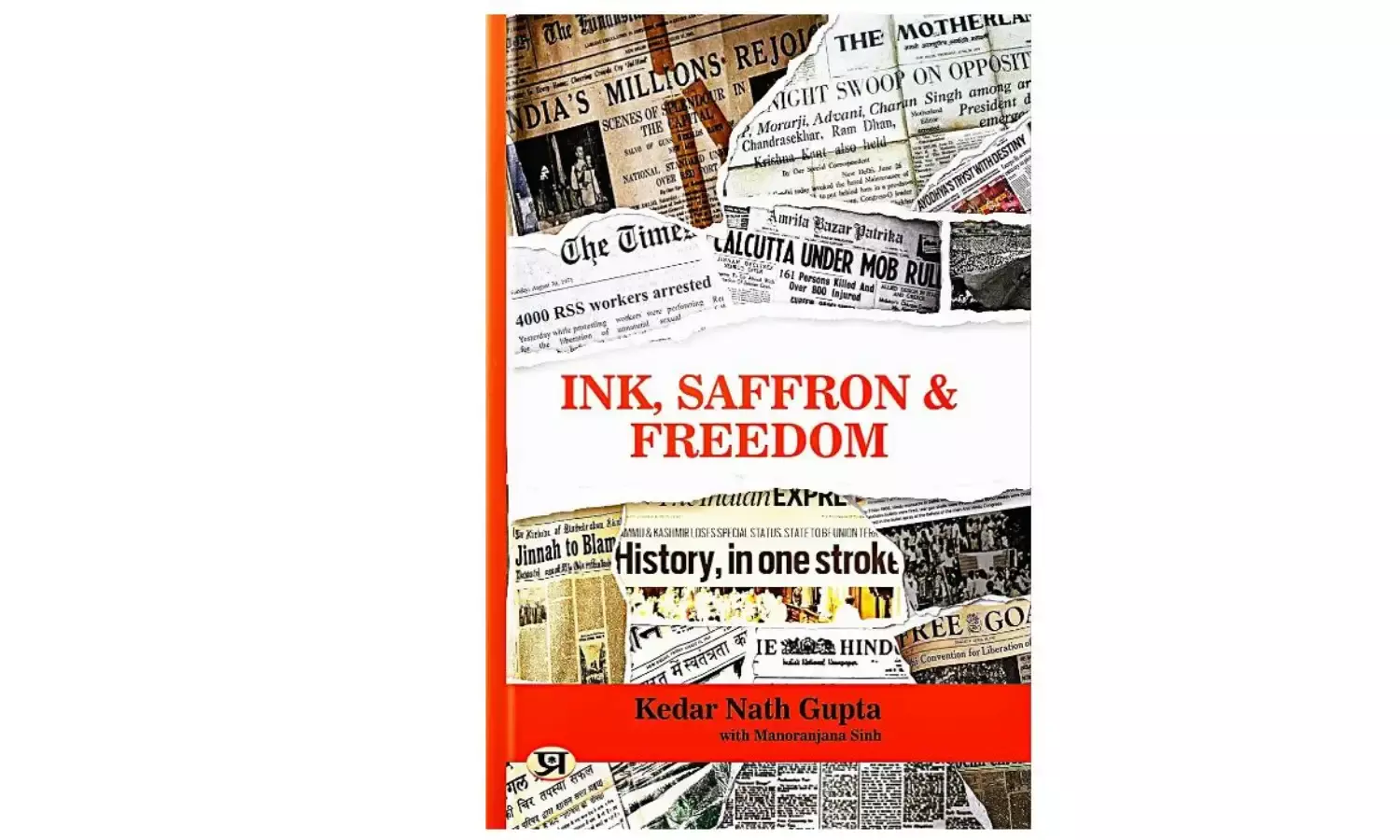
This book, I was able to read, practically non-stop. The style is lucid, the structure is sound, and the logic is limpid.
The chapter headings- The night of the long knives, No bending for some, Crawling for others, Neither tired, nor retired- are hilarious.
Chapter 4 titled BOORA, BARFI, BARBAADI, traces the ancestry of the author in a village called Palhawas, Rewari tehsil, Haryana. The author got his name Kedar because his father’s grandfather went on a pilgrimage to Kedarnath.
“How does one navigate the odyssey of one’s lived experiences”, the author asks in the preface, “memories and emotions, distilling a whirlpool of a life into a few drops of ink?” He found it a daunting affair, and “hence refused to write his memoirs till he could no longer resist his children urging him to write.” The reader is grateful to the children who persisted.
The very title evokes the passion of the authors for fearless journalism, for the ideology of the RSS, and for freedom defined holistically. Even those readers who do not appreciate or endorse the ideology will enjoy reading the book and will be enriched. It is recommended specially for the under-forties.
The authors have come out with this book in 2025 when the RSS is celebrating its first centenary. The RSS chief Mohan Bhagwat has claimed that a ‘Hindu Rashtra’ can include non-Hindus too. This book will help us in figuring out how seriously we should take such claims.
The key question for the reader is: Is the RSS imitating Jinnah in wanting a state based on religion, even after East Pakistan seceded in 1971 and chose to call itself Bangladesh? After all, as the 18th century German philosopher Friedrich Schiller said “The history of the world is the world’s court of justice.”
We know that Field Marshal Asim Munir upholds and propagates the discredited two-nation theory based on religion.
Kedar Nath Gupta (KNG), a professional journalist for over six decades, is deeply devoted to searching for facts, often hidden by interested parties. It has been said that in war the first casualty is truth. We could say with equal justification that in political discourse, not only in India, facts are the first casualty often. President Trump’s Truth Social is a prime example.
Co-author Manoranjan Sinh (MS) is the daughter of KNG, again another professional journalist, fearless and principled. There is a brief reference to the terrorist organization ULFA’s firing ten bullets at her from their AK-47s in 2006. MS did not seek a safer job and continued her work without fear or favor.
The readers would love to read her own account, a more detailed one, in a sequel to the present book that might also show how a younger person is looking at the RSS.
There is a good deal of history in the book as KNG is curious even when he takes a morning walk. We are told fascinating stories about Chawri Bazaar and Nai Sarak as the author narrates the story of his family’s journey.
The chapter titled DIGGING UP BURIED HISTORY gives the history of Siri Fort. How many of us walking there would have taken the trouble to find out that it was built in 1311 AD by Allauddin Khilji? There are three photos of Siri Fort
KNG is proud to be embedded in Delhi. On page 40 there is a photo of him at old Safdhurjung airport in 1957.
The assassination of Mahatma Gandhi by Nathuram Godse on 30th January 1948 had its impact on KNG who was 16 then. He was already in the RSS which was banned on 4th February 1948 by Home Minister Sardar Vallabhbhai Patel.
M S Golwalkar was arrested. He promptly issued a statement dissolving RSS as it has been declared an ‘unlawful body’ by the government.
At this point the reflective reader might wonder how the RSS resurrected itself and grew strong enough such that the BJP begotten by it should be ruling India since 2014. The survival skills of the RSS deserve close study and this book helps.
In this context, KNG’s account of how RSS addressed the challenge will be of interest to the reader who might also note how the politically savvy BJP has virtually monopolized the legacy of Sardar Patel who banned it.
To go back to KNG, he was appalled at the dissolution of the RSS. KNG and others continued with their meetings taking care to deflect attention by replacing khaki shorts with regular trousers.
Their hope that the ban would be lifted soon was belied when Prime Minister Nehru in December 1947 in a letter to state governments stated that there was evidence that the RSS was a private army and that it was adopting the modus operandi of the Nazis.
The RSS leadership cleverly decided to “employ Gandhi’s technique to tackle an increasingly oppressive government that posed a threat to its existence.”
KNG joined four seniors to offer satyagraha at Chandni Chowk. The police flooded the area and KNG and others were taken to the police station. KNG showed his mettle and his account of their treatment by the police should be read keeping in mind how dissent is being dealt with in the ‘new’ Bharat.
What is remarkable and admirable is the sheer courage of the 16-year young KNG. Another characteristic of our hero is his resilience. He walked 16 kms from Indraprastha Gurukul near Faridabad to Darya Ganj in Delhi to appear for the school final examination.
The chapter titled MODI3.0-GUTS AND GUT INSTINCT starts with the qualities of a ‘great gambler” and suggests that PM Modi might be one. “Politics is a game of probability, and Modi, a master of statistics. He not only understands his odds of success and failure but also those of everyone else on the table. However, if there is one thing that you need to understand is that his intuition cannot shield him from occasional failure. Failure is inevitable.”
Referring to PM Modi’s style of decision-making, KNG says that it is difficult to read his intentions. “As with any great gambler who has spent a lifetime at the table with a deck of cards, his play tends to make sense only after he has revealed his cards.”
The reader might like to keep this assessment from the author while trying to figure out the outcome of the gamble being played by Modi with Trump right now.
We all know of Modi’s degree in political science. His knowledge of statistics is news to some of us.
KNG’s style of writing is polite and he knows how to disagree agreeably. Very rarely he resorts to abusive language. For example, he has referred to climate-change activist Greta Thunberg and pop singer Rihanna as “paid assassins” because they supported the farmers’ agitation. Obviously, the editor should have taken care of this.
The author is a devoted advocate of Akhand Bharat. His idea of Akhand Bharat extends beyond the subcontinent to include Afghanistan, Myanmar, and Sri Lanka. Someday, the author hopes, the Bay of Bengal will be re-named as the “Ganga Sagar” and the Indian Ocean as “Hindu Mahasagar”.
The author speaks of “Greater India” in this context. The reader might wonder why he did not include Sumatra captured by the Cholas.
Fortunately, the author is not advocating any military conquest. He prefers “geo-cultural amalgamation” that will eventually lead to a confederation led by Bharat. “The RSS believes that Muslims, even those living in India’s neighborhood, are ‘organically Hindus made different’ by invading forces.”
KNG is deeply interested in history. The chapter titled DIGGING UP BURIED HISTORY gives the history of Siri Fort. How many of us walking there would have taken the trouble to find out that it was built in 1311 AD by Allauddin Khilji? There are three photos of the Fort.
The history as recounted by KNG is by and large reliable. However, the young readers might note that in giving an account of the liberation of Goa, there is no word about the role played by V K Krishna Menon, the defense minister.
The 32-page long Epilogue with lovely photographs is the best part of this book. KNG here sums up his teleologic philosophy of life as he recollects the story so far. “I was gifted a meaningful life generous with learning and discovery because some 350 -odd years ago, my ancestors, for better or worse, took a gamble when they untethered themselves from Palhawas and ventured northwards towards Delhi.”
Though this reviewer does not share the ideology of the R.S.S., he has no hesitation in recommending this book to all those who want to understand contemporary India, whether they have an ideology or not. In fact, the youth should read this book to understand the past and the present and it will help them to envisage a proper future for India. The book is fortunately free from loud ‘sloganeering’, rather fashionable these days.
The publisher Prabhat Prakashan has done a good job. An index can be added to the next edition.
This book should be translated into other languages including Bangla, Marathi, Malayalam, Kannada, and Telugu. This book will be of interest to the entire subcontinent and an Urdu edition is called for as the book will be read in Pakistan too.
One of the misfortunes of South Asians is their inability to communicate across national borders. In India we cannot access by the net the Pakistani daily The Dawn. One wonders whether in Pakistan they can access the Indian dailies.
The cultural amalgamation advocated by the author calls for a change of policy on the part of the Central government, though he has not said it.
Ink, Saffron & Freedom
Kedar Nath Gupta with Manoranjana Sinh
Prabhat Prakashan, New Delhi.
Ambassador K.P.Fabian retired from the Indian Foreign Service. The views expressed here are the writer’s own.