

- >>
- OPINION
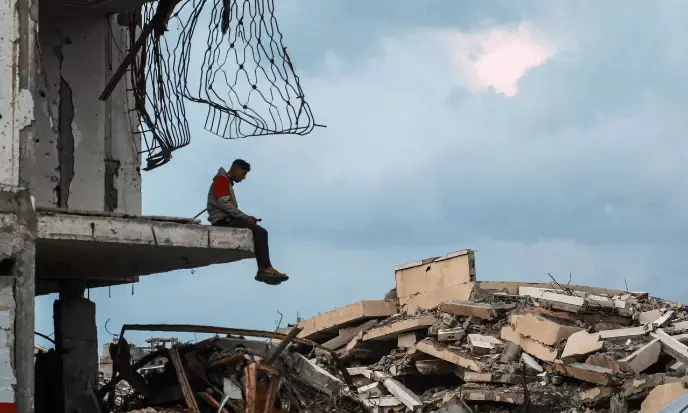
Despite the ceasefire, Israeli forces remain deployed in over 50% of the Gaza Strip, with ongoing reports of gunfire and shellfire causing further casualties.
Since the October 10, 2025, ceasefire, over 590 Palestinians have been killed, with hundreds of bodies recovered from under the rubble. Thousands of individuals remain missing, buried under the rubble of destroyed buildings, with estimates suggesting this figure could exceed 10,000.
UNICEF reports that over 100 children were killed between the October 2025 ceasefire and mid-January 2026, averaging roughly one child fatality per day during that period.
Only about half of Gaza's hospitals are only partially functional, with 48% of primary healthcare centres operational. Medical evacuations have been severely limited, leaving over 18,500 patients, including 4,000 children, in urgent need of care outside the Strip.
The conflict has been described as the deadliest for journalists in decades, over 250 journalists and media workers killed. Additionally, nearly 400 UNRWA workers have been killed.
Food insecurity is severe, and. that, may be just be an understatement. Projections for early 2026 indicate that over 100,000 children and 37,000 pregnant/breastfeeding women are at risk of acute malnutrition.
Approximately 1.4 million people, two-thirds of the population, are living in around 1,000 makeshift displacement sites in harsh winter conditions.
Meanwhile, despite the so-called ceasefire, on January 8, 2026, Israeli strikes in the southern and northern Gaza Strip hit tents and homes, killing seven civilians, including five children. Unexploded ordnance, over 30 incidents have been reported since the October 2025 ceasefire, resulting in nine deaths and 65 injuries.
Israel has already reduced The Gaza Strip to rubble. Over 80% of buildings in the Gaza Strip have been damaged or destroyed, creating an estimated 50–61 million tons of debris. This amount of rubble is enough to fill New York City's Central Park 12 meters deep, or roughly 12 times the volume of the Great Pyramid of Giza.
Even if rubble removal operated at full capacity, it is estimated that it would take at least 15 years, and potentially up to 30 years, to clear the debris, which is laced with unexploded ordnance, hazardous materials, and human remains. Approximately 245,000 to 320,000 housing units have been damaged or destroyed, displacing over 1.9 million people, or about 90% of the population.
70% of Gaza's water and sanitation plants, including all five wastewater treatment facilities. The blockade, in place since 2007, caused "utter ruin" and a 40-year regression in human development, reducing the economy to 83% lower than pre-war levels.
Most hospitals are non-functional, and the healthcare system has "totally collapsed," with disease outbreaks including polio reported due to sewage and waste contamination. A "complete lack" of electricity, limited food, and restricted access to clean water have created conditions that the UN has described as simply uninhabitable.
Rebuilding Gaza is estimated to cost between $50 billion and $80 billion, with the UN indicating that returning to the pre-2007 status quo could take 350 years. The devastation has left behind a "double cemetery" of both destroyed infrastructure and unburied bodies trapped under the rubble.
Israel had laid the foundations for the whole-sale destruction of Gaza during the 15-year blockade. After October 2023, Israel went on a rampage that was barbaric, to say the least.
In early 2026, Donald Trump dreamed up a nightmare for the people of Gaza and a ecstatic $2 billion+ initiative to transform the Gaza Strip into a "luxurious oasis" and seaside metropolis, featuring high-rise towers, a new port, and, in some visions, an Elon Musk-style tech hub. The plan aims to rebuild Gaza into a tourist, industrial, and residential centre, focusing heavily on waterfront development.
The plan aims to rebuild Gaza into a tourist, industrial, and residential centre, focusing heavily on waterfront development. Trump has labelled Gaza "some of the best real estate" in the world, aiming to capitalize on its coastal location to turn it into a high-value, developed area.
Many Palestinians and observers view the proposal as an externally imposed, "imperial" agenda that sidesteps local voices and focuses on foreign investment rather than local empowerment. Moreover, investor confidence is low due to the risk of renewed conflict, questioning whether a, "New Gaza" can be secured.
Some proposals linked to this vision have included controversial ideas like the voluntary relocation of the population. In their arrogance and naïveté, Israeli officials have promoted "voluntary migration" as a "safe and controlled" way to leave war zones, the prevailing view is that the conditions in Gaza make any such move coerced rather than voluntary, rendering the plan unworkable.
Voluntary relocation of the population of Gaza is widely considered highly unfeasible, practically impossible, and legally invalid, with critics and international bodies framing such proposals as forced displacement or ethnic cleansing.
Human rights organizations and the UN have warned that forcing or coercing the population to leave constitutes a breach of international humanitarian law, particularly the Fourth Geneva Convention, and could be seen as a war crime or ethnic cleansing.
The UN has confirmed that "voluntary migration" has no legitimacy in the context of a war, blockade, and humanitarian catastrophe. International law dictates that any population displaced from occupied territory must be allowed to return voluntarily to their homes.
The "Board of Peace," launched by U.S. President Donald Trump at the World Economic Forum in January 2026, is a controversial initiative designed to oversee the reconstruction and administration of Gaza following a ceasefire. While presented as a "bold new approach" to conflict resolution, critics have heavily criticized it as a "pay-to-play" structure that acts as a "coercive colonial plan" or a "neo-imperial" project, aimed at sidelining the United Nations.
The Board For Peace excludes Palestinians from the decision-making process, replacing local governance with a "technocratic committee" and an "International Stabilization Force" that denies Palestinians control over their own security and territory. The initiative involves foreign investors and governments taking control of Gaza's land and resources, resembling a colonial-era trusteeship.
Permanent membership in the board requires a $1 billion contribution to a reconstruction fund, heavily favouring wealthy nations and creating a "corporate" structure rather than a rights-based humanitarian effort. The board is chaired for life by Donald Trump, who holds a veto over decisions and can appoint his own successor, concentrating authority rather than relying on multilateral consensus.
Critics have pointed out that the official charter of the board does not specifically mention Gaza, suggesting the initiative is designed as a broad, undefined tool for US intervention elsewhere, rather than a focused peace effort.
The board – a non-conventional international body, is a "top-down project" that lacks a clear legal personality, leading to concerns about its legitimacy. It would operate outside established international law, creating a parallel structure that weakens the United Nations.
European allies, including France, have expressed concern that the initiative seeks to usurp the role of the United Nations Security Council. While some countries (e.g., Saudi Arabia, Turkey) initially engaged, many other countries, including India, have acted with caution or stayed away, questioning the legitimacy of a,1 billion fee for joining.
A worst-case scenario for the Gaza Strip and the "Board of Peace" involves the total collapse of aid, widespread famine, and permanent displacement, with the Board acting as a mechanism for, rather than a solution to, the suffering.
This scenario includes the entrenchment of a "two-tiered structure" that sidelines Palestinian voices, a continued blockade causing mass starvation, and the potential for international forces (like those from Indonesia) becoming caught in, or inadvertently enabling, ongoing Israeli military actions.
The board represents a shift toward "minilateral" or ad-hoc arrangements, allowing the U.S. to bypass the complex, sometimes stalled, UN decision-making process. The executive board includes figures such as Jared Kushner and former UK Prime Minister Tony Blair.
The Board of Peace is viewed by many as a mechanism that prioritizes "control architecture" over genuine peace, using financial power to impose a US-led governance structure in Gaza.
Ranjan Solomon has worked in social justice movements since he was 19 years of age for an accumulated period of 58 years working with oppressed and marginalized groups locally, nationally, and internationally. The views expressed here are the writer’s own.