

- >>
- OPINION
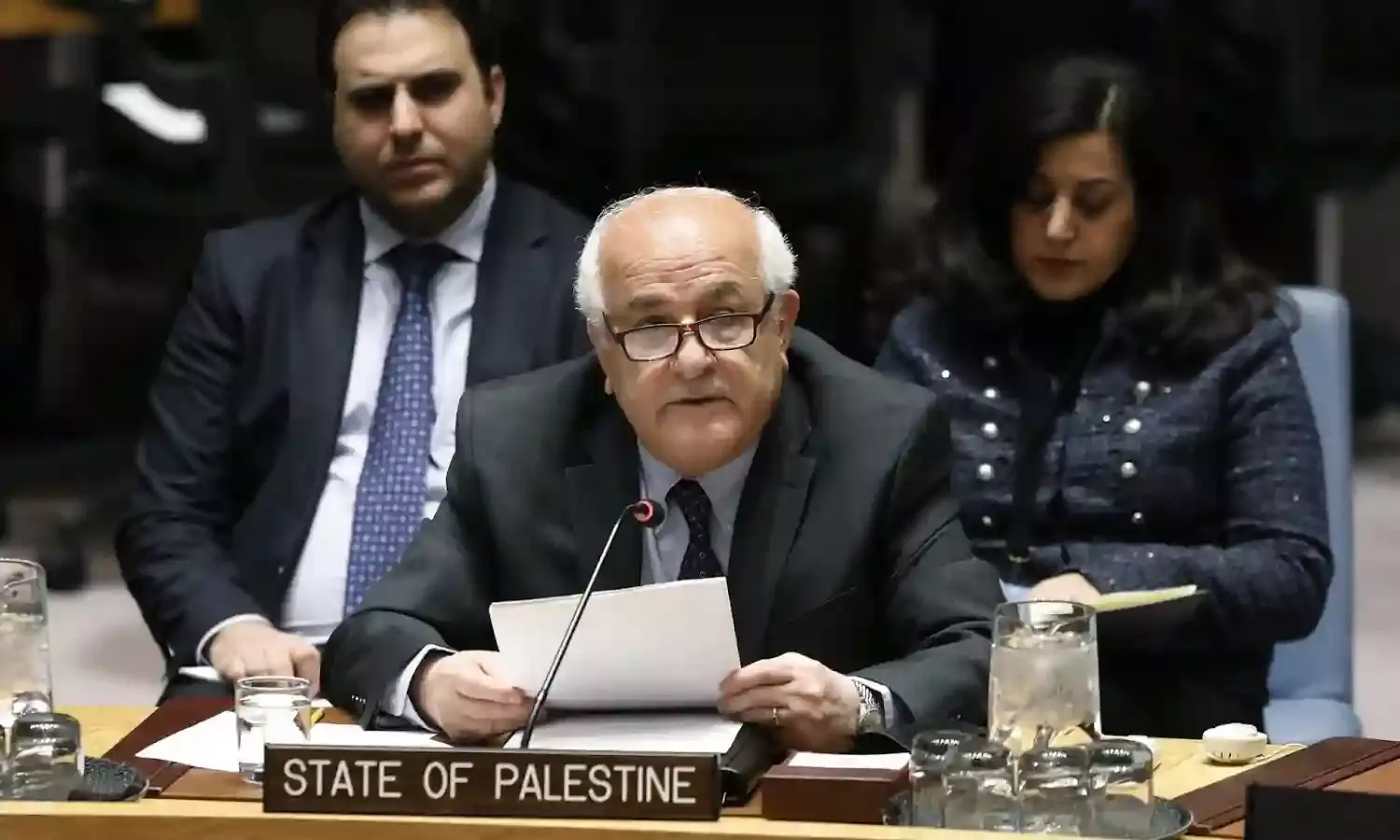
The United Nations General Assembly opens its 80th session this week under a dark shadow. The previous year’s work has barely closed, yet the moral authority and political credibility of the institution are already being tested in a manner unseen since its founding.
As Craig Mokhiber, human rights attorney and former head of the UN’s New York Office of the High Commissioner for Human Rights, has urged, the General Assembly has the tools and the mandate to act immediately to end the genocide in Gaza and the entrenched apartheid system under which Palestinians live.
The question is not whether the UN has the authority to intervene. The question is whether it has the courage to use it.
Mokhiber has pointed out that under the “Uniting for Peace” mechanism, the General Assembly could deny Israel its credentials, impose sanctions and a military embargo, establish a criminal tribunal, reactivate the anti-apartheid mechanisms that once confronted South Africa, and mandate a UN protection force for Palestine.
None of this would require the permission of the Security Council. With a two-thirds vote, not the United States, not Israel, nor even the Secretary-General could stand in the way. In other words, the world already has a legal pathway to act. What is lacking is the political will to summon it into being.
The 1950 “Uniting for Peace” resolution (UNGA Resolution 377) was born in a moment of crisis. When Cold War paralysis prevented the Security Council from acting in the face of aggression in Korea, the General Assembly asserted its own authority. Resolution 377 established that when the Security Council is deadlocked by vetoes, the General Assembly “shall consider the matter immediately with a view to making appropriate recommendations to Members for collective measures, including in the case of a breach of the peace or act of aggression the use of armed force when necessary.” The intent was clear: the paralysis of the Security Council would not mean the paralysis of the United Nations as a whole.
If ever there was a case for invoking “Uniting for Peace,” it is Palestine. The genocidal violence in Gaza, documented by multiple UN experts and affirmed as “plausible genocide” by the International Court of Justice in January 2024, cries out for immediate intervention. Israel’s apartheid regime, long compared by South African veterans of the anti-apartheid struggle to their own oppressor, fulfils the definition set out in the 1973 International Convention on the Suppression and Punishment of the Crime of Apartheid.
The world’s conscience recognizes this, yet the Security Council is paralyzed by a permanent veto power that shields Israel from accountability. The General Assembly, representing the collective will of nations, must step in.
Denying Israel’s credentials at the UN would not mean expulsion, which requires Security Council approval. But it would strip Israel of its legitimacy to participate in the deliberations of the international community. This is not without precedent: South Africa faced similar action in the 1970s, when its credentials were rejected because of apartheid. The move galvanized international opinion and helped isolate the regime until it fell.
Sanctions and a military embargo, similarly, are tools the General Assembly has recommended in the past. Against Rhodesia, against apartheid South Africa, and against regimes guilty of aggression, sanctions have been a way for the Assembly to mobilize global solidarity. An arms embargo against Israel would be a minimal step to halt the continuous flow of weapons used in the destruction of Palestinian lives and infrastructure.
Mokhiber’s call for a special criminal tribunal echoes the precedents of the International Criminal Tribunal for Rwanda and the former Yugoslavia. These tribunals were not created by the General Assembly, but by the Security Council. Yet the General Assembly could recommend and initiate the establishment of a tribunal with wide participation by member states, and it could urge the International Criminal Court to accelerate its ongoing investigations.
The Assembly could also revive the anti-apartheid mechanisms—such as the Special Committee Against Apartheid—that once served as platforms to mobilize the world’s conscience and coordinate global campaigns.
Perhaps the most urgent measure is the deployment of a UN protection force for Palestine. This is not about taking sides in a conflict. It is about protecting civilians, facilitating humanitarian aid, preserving evidence of crimes, and assisting in reconstruction.
In the aftermath of genocide in Rwanda and Srebrenica, the UN has sworn “never again.” Yet “again” is happening before the world’s eyes in Gaza. The Assembly could mandate such a force, and while deployment would require cooperation from member states, the political momentum created by a General Assembly vote would make inaction increasingly costly.
Dag Hammarskjöld, the UN’s second Secretary-General, once observed: “The United Nations was not created to take mankind to heaven, but to save humanity from hell.” Gaza is hell today. Hammarskjöld’s warning rings with tragic resonance: if the UN cannot act here, at what point does it surrender its moral claim to exist?
The comparison to the League of Nations, which collapsed in irrelevance as fascism rose in the 1930s, is not hyperbole. If the United Nations proves itself incapable of defending the most fundamental principles of its Charter - the prohibition on genocide, the protection of civilians, the right of peoples to self-determination—then it is not simply Palestine that is endangered, but the entire edifice of multilateral order.
The crisis is not only about Palestine. It is also about where the UN itself resides. Recent reports of the United States denying visas to Palestinian officials, including President Mahmoud Abbas, strike at the heart of the UN’s legal framework. Under the 1947 UN Headquarters Agreement between the United Nations and the United States, the host country is obliged to ensure that representatives of all member states can access UN meetings, regardless of political disputes. Refusal to grant such access is a violation of international treaty obligations.
This raises the pressing question: should the UN remain headquartered in New York? There is precedent for relocation. Geneva already hosts the Human Rights Council, the World Health Organization, and numerous other UN agencies. It is a neutral location, better aligned with international law, and free of the host-state pressures that undermine the UN’s independence. Moving the UN’s central organs to Geneva—or even creating a rotating headquarters system—would send a message that the UN belongs to all peoples, not to the geopolitical calculations of its most powerful host.
As the 80th General Assembly opens, one unavoidable demand that must take centre stage is the call for a UN Protection Force. Decades of experience have proven that resolutions, condemnations, and statements of concern - without protective mechanisms—do little to shield vulnerable populations.
In Gaza, Sudan, Myanmar, Kashmir, and elsewhere, entire communities live under siege, deprived of basic security and exposed to the unchecked brutality of military powers. The United Nations was not created merely to issue reports; it was established to prevent mass atrocities and safeguard civilian life. That mandate has been repeatedly betrayed.
The principle of the Responsibility to Protect (R2P) - adopted in 2005 - was meant to give the UN teeth in preventing genocide, war crimes, ethnic cleansing, and crimes against humanity. Yet geopolitics and vetoes have turned it into a hollow slogan. When member states obstruct protective missions, they abandon not only victims but also the credibility of the UN itself.
The call for a UN Protection Force, whether in the form of peacekeepers, civilian monitors, or protective missions, must therefore be revived and insisted upon at this General Assembly. Without it, the institution risks becoming complicit through inaction.
The demand for protection is not abstract. It is the voice of mothers in refugee camps, of children who survive bombardments, of communities displaced and silenced. If the UN fails to act with courage now, it risks irrelevance. Protection is the minimum measure of its legitimacy. To shirk this duty is to betray its Charter and the very humanity it was created to defend.
The UN is not just an institution of diplomats. It is the fragile embodiment of humanity’s hope to solve its gravest crises collectively. That hope is now on trial. If the General Assembly acts, it may yet redeem the principles for which the UN was created. If it does not, it risks descending into the same irrelevance that consumed the League of Nations.
In the end, the judgment is twofold: the UN is on trial before the world, and humanity is on trial before itself. To act for Palestine is to act for the survival of multilateralism. To fail is to watch not only Gaza burn, but also the credibility of the very institution meant to prevent the next war, the next genocide, the next hell.
On 9 September 2025, former German Foreign Minister Annalena Baerbock assumed her functions as President of the United Nations General Assembly (UNGA). With a record of promoting militarisation, blocking ceasefire efforts and undermining international diplomacy and justice, Baerbock’s values are fundamentally at odds with the mission of the United Nations. That is why progressive global civil society groups are escalating the campaign against her presidency.
The International Association of Democratic Lawyers, Progressive International and CODEPINK are mobilising to highlight imperialism’s continued efforts to erode international institutions, and to bring attention to Baerbock’s crimes, and to demand her resignation from the post. The President of the UNGA must belong to someone whose track record is impeccable; not stained and muddied by prejudice.
Baerbock led the call to remilitarize Germany and pull Europe into armed interventions abroad and has justified attacks on civilians under the guise of “self-defense”. She has further blocked ceasefire efforts as Israel devastated Gaza and refused to enforce arrest warrants for Israeli officials implicated in crimes against humanity. Baerbock attacked South Africa’s ICJ case against Israel, rejecting it as “baseless” despite the court’s findings.
Micòl Savia, General Secretary of the International Association of Democratic Lawyers (IADL), declared: “By backing her name for the position, the West clearly has indicated its vile intent to undermine international law and international institutions. A warmonger and genocide enabler presiding over the UN General Assembly is an affront to humanity and the Rule of Law. Shame on them!”
Desmond Tutu, the prodigious activist-liberation theologian, spoke these predictive words: "It means a great deal to those who are oppressed to know that they are not alone. Never let anyone tell you that what you are doing is insignificant."
For all its flaws, the UN has never been a self-acting entity. It moves when states demand it, and states move when people demand it of them. The anti-apartheid struggle taught us that global solidarity - manifested in boycotts, divestment campaigns, cultural resistance, and mass mobilizations - can bend the arc of history. Today, the same is true for Palestine. Citizens must write, speak out, and demonstrate to compel their governments to act in the General Assembly.
The demand is simple: invoke Uniting for Peace, deny Israel’s credentials, impose sanctions, establish a tribunal, revive anti-apartheid structures, and deploy a protection force. The pathway exists. The moral urgency is undeniable. The only barrier is political will, and political will is never given freely - it is demanded by the weight of popular pressure.
Ranjan Solomon is a political commentator and a Palestinian rights advocate for four decades. The views expressed here are the writer’s own.