

- >>
- OPINION
Violence- the word we may well recoil from, especially if it is expressed so forcefully, in conversations and in action. What is sad though, is that of late violence has become an accepted norm, especially in the games that children play; in the streets where adults perform; and in the cinema that plays with the sentiments of both.
What is even more unfortunate is that we often forget that this ‘negativity’, whether expressed in its sheer brutality or in forms more subtle, is often so well hidden that we do not even realize that we are now raising a sadistic generation that is slowly becoming immune to this aggressive emotion.
Before the Internet and social media, the only reality of a war we witnessed was through Radio, Newspapers or Cinema. Most of us were conditioned to see military combat as exciting and glamorous- an opportunity for men to prove their bravery, their competence and their courage. We were brainwashed into thinking that since armies are legal, war is acceptable. Thus everyone tolerated its criminal attitude. But now we know.
We know how wars are planned. We know how they are orchestrated by a bunch of dictators and unscrupulous politicians just to ‘trump’et their own achievements. We know that what follows is nothing but land and oil grabbing, bringing sorrow, death and economic hardship to the nation. We know that it’s just a monopoly of power, not glory.
There is no such thing as a warless war. War is ruthless. War is monstrous. It is neither glamorous nor attractive. It is like a fire that spreads in a jungle where the fuel is not trees but humans. Every tool of warfare, whether ancient or modern, whether it is swords, battle shields, tanks or drones is a mask for a ‘matchstick’. But we are so conditioned to see it as thrilling that we talk about this or that marvelous weapon as a remarkable piece of technology.
We forget the fact that the fire of a war begins without our consent. It continues without our permission. And it ends up burning and blazing the human community, where mothers, fathers, wives, brothers and sisters also live.
Among the many horrors of war, the death of soldiers has always stood apart- what we assume as ‘bravery’ is nothing but a special kind of tragedy. It is like throwing live people onto a fire. But because we have stars in our eyes for gallantry awards, we do not consider the suffering of individual soldiers. No soldier willingly wants to be wounded. No one wants to die. None of his loved ones wants any harm to come to him. If one soldier is killed or maimed for life, at least another five or ten people - his relatives and friends - suffer as well. In reality anyone with a heart and soul should all be horrified by the extent of this tragedy. But we are too confused.
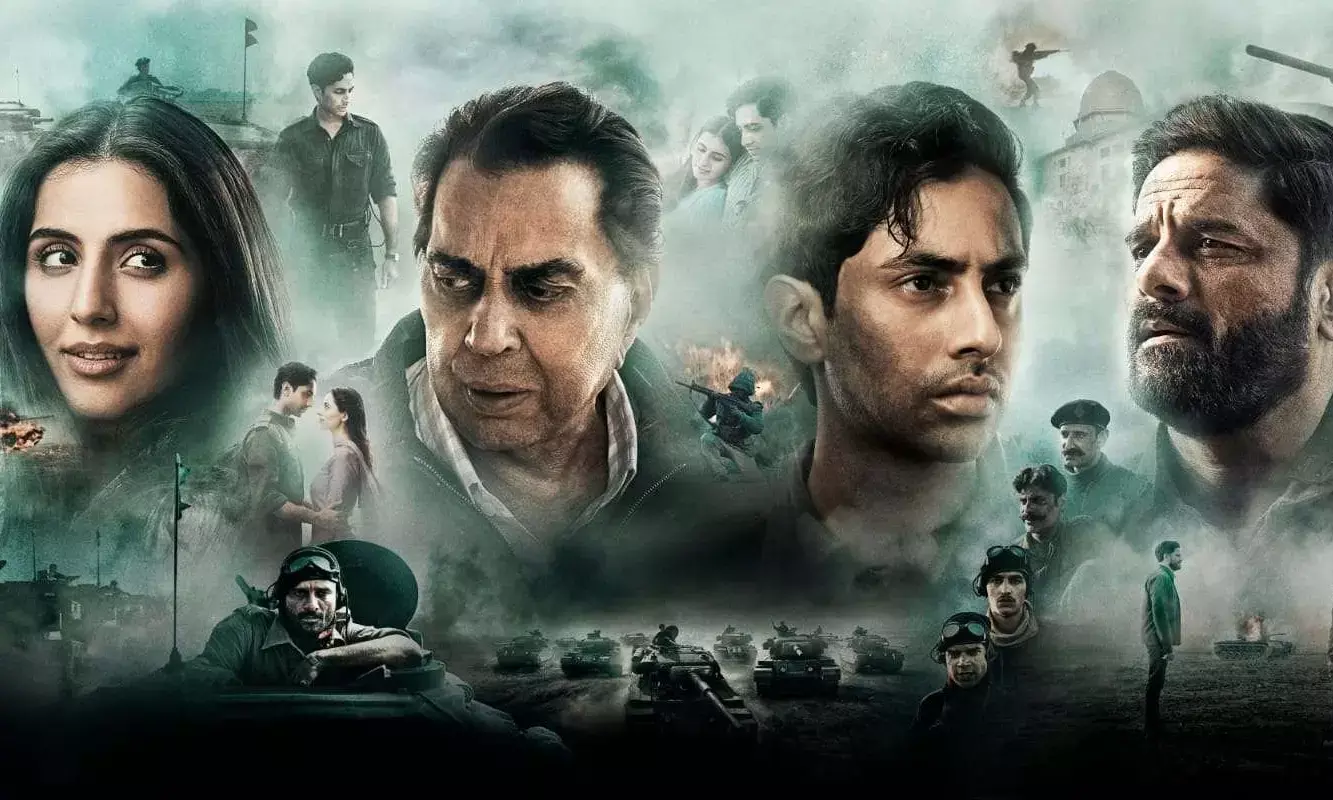
And this is what is so beautifully captured in ‘Ikkis’- a humane war drama that not only carefully balances gallantry with empathy, making it a war film that feels authentic and expressively resonant. Its emotional core rests in an intimate off battlefield confrontation that explores a soldier's duty, his sacrifice and the psychology of those he leaves behind.
When a war film opts for realism instead of patriotism; when it is told with sensitivity and emotional depth; when it is tempered by forgiveness; when it honours bravery in its truest form without the gory shades of masculinity and heroism; when it is softly layered with tenderness and the warmth of human bonding; it firmly delivers a strong commentary on duty for your nation, all the time reminding you of the real cost of freedom and of young lives.
For anyone with a conscience, this movie will shake you to the core, going way beyond your comfort zone, only to understand and give a quiet respect that is shared by ALL the soldiers on the battlefield. And to all their families!
P.S. This is not just a review of a film. It is the reflection of a bitter reality- of wars and of shared cultures. It is also a silent tribute to Dharmendra- our legendary star with a deep desire for peace, who served as a cultural bridge between two nations, once connected by history and heart. His comfortable portrayal and his genuine performance in the film perhaps stems from his Punjab roots and his first love called Hamida, who he lost when he migrated during the Partition. Dharmendra described Pakistan as his ‘Mausi’ (aunt) and hinted with nostalgia, that if countries embraced like mothers, their children would finally find peace. Embodying the syncretic culture of Punjab (shared by both nations) he remained connected to his roots with a consistent message of Peace. This made him a symbol of goodwill, even amidst political tensions. He expressed a wish for ‘Ikkis’ to be seen by audiences both in India and Pakistan. Unfortunately, the artist himself did not live long enough to hear the melody or witness the complete version of his own Swan Song.
Nargis Natarajan writes on issues of social relevance. The views expressed here are the writer’s own.