

- >>
- OPINION
Peoples Of The World Respond To Gaza
Governments, with a few exceptions, stay silent
UN Secretary-General António Guterres said the results of the Integrated Food Security Phase Classification (IPC) analysis were no mystery: “Famine is not about food; it is the deliberate collapse of the systems needed for human survival.” Guterres termed the catastrophe as a human-made disaster, a moral indictment – and a failure of humanity itself”. Israel’s apartheid regime has conducted its project of starvation in public view of cameras and television with no remorse.
Guterres went a step further with a blistering indictment of the indifference of States who displayed unwillingness to push relief when deeply needed. The inaction is a brazen ‘don’t-care’ display of consenting to starvation as a weapon of engineered warfare and abandoning the Palestinian people when a simple act of stubborn insistence could save thousands lives. International indifference feels as if Israel’s conceited plan to kill as many Palestinians in Gaza not just with weapons but by starvation has tacit and widespread indifference by countries who have shown self-seeking political opportunism.
Research by Forensic Architecture (FA) has demonstrated that the Israeli military pursued a deliberate strategy of starvation and famine. In a report, FA specifies how Israel has imposed on Palestinians an inhuman pathway that compels them to travel long distances to reach military-run distribution centres. In the most cruel and inhumane acts of hate, the army then opens fire at aid points knowing for certain that civilian targets are mere sitting ducks. FA avers that Israel’s targeting of aid and its persistence with its own typical design of aid distribution has gotten starvation in Gaza to crisis point.
FA’s report establishes how Israel took down a ‘civilian model’ of aid distribution that had functioned positively through a network of international and local humanitarian organisations, in alliance with civil structures and staff-volunteers, to deliver aid directly to the people of Gaza. By contrast, the Gaza Humanitarian Foundation (GHF) used methods that deprive the recipients of food, and their dignity. It puts them in harm’s way using airdrops which neither suspend the threats of starvation but render the aid distribution itself dangerous, and deficient to prevent starvation. The methods of the GHF are not humanitarian by any standards; instead. They serve to dehumanize its receivers.
“As the occupying power, Israel has unequivocal obligations under international law – including the duty of ensuring food and medical supplies of the population,” said the UN chief, reacting to the famine declaration from the IPC. Dozens of governments, UN agencies and NGOs agree with this assessment. Mr. Guterres said Israel’s denial of its duties could not be allowed to continue: “No more excuses. The time for action is not tomorrow – it is now.”
UN agencies operating in Gaza joined the UN chief in calling for an immediate ceasefire to finally allow unimpeded, large-scale humanitarian response and the immediate release of all hostages taken by Hamas and other militants during the 7 October 2023 terror attacks.
Agencies also expressed grave concern over the threat of the intensified military offensive on Gaza City and any further escalation in the conflict, as it would have further devastating consequences for civilians where famine conditions already exist. UN agencies define famine as a context when the most extreme category is ruptured around three critical thresholds – extreme food deprivation, acute malnutrition and starvation-related deaths – have been ruptured.
Reports have it that while food stacks up at borders because of systematic obstruction by Israel. It is a famine within a few hundred metres of food, in a fertile land. It is a famine that we are repeatedly warned of. Yet the international media has not been allowed in to cover, to bear witness. It is a dreadful and perilous 21st century famine that is overseen by drones and the most advanced military technology in history. It is a famine openly promoted by some Israeli leaders as a weapon of war. The famine has been legitimised by Israel sanctioned by the silence of the world and Israel’s political choice to place Gazans in the most inhuman ways possible. It’s getting to where it out beats even the hideous Nazi genocide of the Jews.
Shahin Ashraf, Islamic Relief World Wide’s Head of Global Advocacy, offers her insight into what the IPC Phase 5 classification means for families in Gaza. In a poignant message she conveys how “every morning, the images of families being starved in Gaza spill across our screens during breakfast, on the commute to work and other moments that used to feel mundane. But now, nothing feels ordinary. Nothing should. We are not simply witnessing a crisis, but a human, man-made catastrophe unfolding in real time. A mother cradles her toddler not to lull her to sleep, but to soothe hunger cramps that wrack her tiny body. Men running toward food trucks in desperation are shot down before they reach them. These are not isolated scenes. This is the daily reality facing families in Gaza”.
Jeffrey D. Sachs, a globally renowned economist, is unequivocal when he calls on the international community to dare the US: “Even in the face of American intransigence, the world can act -and the US government will stand naked and alone in its criminal complicity with Israel… The world is aghast but seems paralyzed before the Israel-US murder machine. Yet the world can act, even in the face of US intransigence. The US will stand naked and alone in its criminal complicity with Israel.
The overwhelming voice of humanity is on the side of the people of Palestine. Last December, 172 countries, with more than 90 percent of the world population, voted to support Palestine’s right to self-determination. Israel and the US were essentially isolated in their opposition. Similar overwhelming majorities are repeatedly expressed on behalf of Palestine and against the actions of Israel. Israel’s thuggish government now counts solely on US support, but even that may not be there for long.
How can the world punish Israel while ignoring and isolating both Israel?
- Nations should terminate all economic, trade, shipping, and air links with Israel. Türkiye has set a model of shutting down relations with Israel until Israeli-created mass starvation is reversed.
- The State of Palestine must find its rightful place in the UN as the 194th member, with the borders of June 4, 1967. Towards that, all UN member states that have not yet done so should recognize the State of Palestine. But it will not suffice to recognize Palestine. Israel must be treated as a pariah State – derecognized until it accepts international law, agrees to implement all UN resolutions that have been passed against its human right violations. (From 2015 through 2023, the UN General Assembly has adopted 154 resolutions against Israel. The UN Watch Database also documents that from 2006 through 2024; the UN Human Rights Council has adopted 108 resolutions against Israel.
- Arab signatories to the Abraham Accords, Bahrain, Morocco, Sudan, and the UAE, should suspend their diplomatic relations with Israel until the Gaza siege ends and the State of Palestine is admitted to the UN. The UN General Assembly, by a vote of two-thirds present and voting, should suspend Israel from the UN General Assembly until it lifts its murderous siege on Gaza, based on the precedent of suspending South Africa during its Apartheid regime. The US has no veto in the UN General Assembly.
- UN member states should stop the export of all technology services that support the war, until the siege of Gaza ends and Palestine’s membership in the UN is adopted by the UN Security Council. Consumer companies such as Amazon and Microsoft that persist in aiding the Israel Defence Forces in the context of a genocide should face the wrath of consumers worldwide.
- A substantive measure that the UN General Assembly should adopt is a decision to authorise a UN Protection Force to Gaza and the West Bank. Under the "Uniting for Peace" mechanism, when the Security Council is deadlocked, the authority to act passes to the General Assembly. There, the General Assembly can, by a two-thirds majority not subject to US veto authorize a protection force in response to an urgent request from the State of Palestine.
There is a precedent: In 1956, the General Assembly authorized the UN Emergency Force (UNEF) to enter Egypt and protect it from the ongoing invasion by Israel, France, and the United Kingdom. This protection force would enter Gaza to secure emergency humanitarian aid for the starving population. If Israel were to attack the UN protection force, the force would be authorized to defend itself and the Gazans. Whether Israel and the US would dare to fight a UNGA-mandated force is very doubtful.
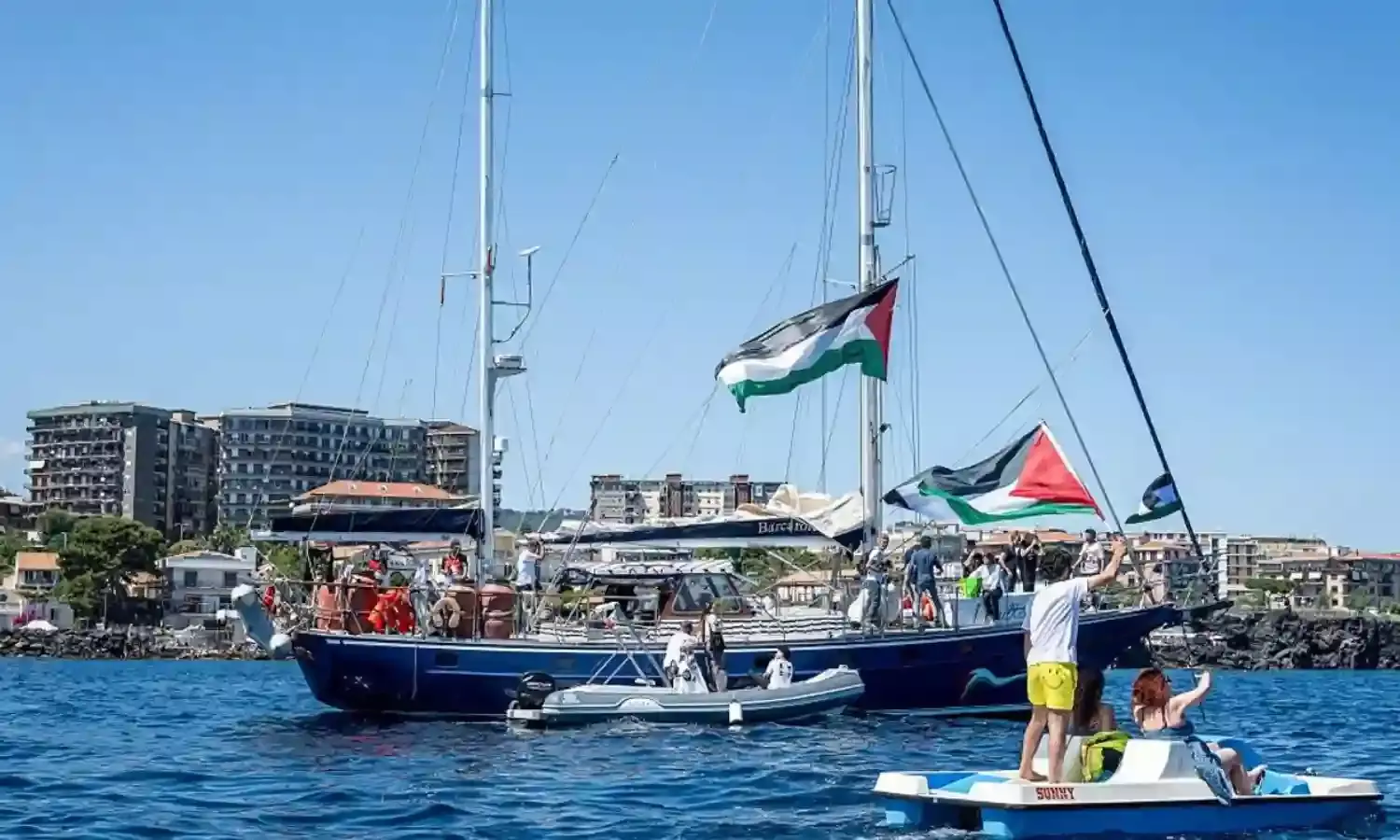
The Global Summud Flotilla, along with previous Freedom Flotillas, is described as a resilient act of defiance against the Israeli blockade of Gaza, aiming to deliver humanitarian aid and highlight the humanitarian crisis there. The flotillas challenge the legality of the blockade and Israel's actions through peaceful, non-violent civil resistance, bringing international attention and pressure to end the siege and ensure access to essential supplies for the Palestinian population in Gaza.
A flotilla is a fleet of ships and boats are civilian-led initiatives involving activists, humanitarians, and notable figures sailing to Gaza to break the Israeli blockade. They are resilient despite previous attempts being intercepted or blocked by Israeli forces. These flotillas continue to be organized, demonstrating the sustained commitment of the people and bring huge attention even through the corporate and mainstream media. participants.
Flotillas demonstrate the courage and determination of activists to sail into a conflict zone, facing the risk of detention or interception, to stand in solidarity with Palestinians. They carry essential aid, like food, water, and medicine, to a population facing starvation and humanitarian catastrophe.
They represent an act of "defiance" of Israel's naval blockade of Gaza, which has been in place for years. By directly challenging the blockade through non-violent means, the activists engage in civil disobedience to pressure Israel to lift the illegal restriction. The flotillas assert that the blockade is a violation of international law and human rights, highlighting the responsibility of the international community to act. Each intercepted vessel or detained activist serves to keep the world's attention on the plight of Gazans and the ongoing humanitarian crisis, ensuring that Gaza is not forgotten.
A union representing dockworkers at one of the largest ports in the Mediterranean – a key stopping point for Israel goods – has said it will ‘block everything’ if Israel stops in the inbound aid flotilla.
Trade unions' actions, such as global labour complaints, calls for boycotts, and disrupting arms shipments, contribute to Israel's international isolation by highlighting human rights abuses and pressuring governments to take action against Israeli policies, particularly regarding Palestinian workers and the conflict in Gaza. For example, unions have filed complaints about wage theft against Palestinian workers. Nine global trade unions, representing over 207 million workers, filed a complaint with the International Labour Organization (ILO) against Israel for wage theft and withheld benefits from Palestinian workers, leading to severe financial hardship and echoing calls for broader action.
Workers and trade unionists have disrupted the manufacturing and handling of arms destined for Israel in response to the assault on Gaza. The actions by trade unions elevate the visibility of alleged human rights abuses and economic exploitation by Israel, garnering international attention and support from other civil society organizations. These actions demonstrate solidarity with Palestinian workers, amplifying their calls for justice and pushing for an end to exploitative labour practices.
There is a call for the closure of the Suez Canal recognizing it would significantly affect Israel's trade by increasing shipping costs and transit times, as their primary routes for goods from the East and West are disrupted, forcing them to use longer, more expensive alternatives. Israel is most vulnerable due to its geographic position and reliance on maritime trade. Rerouting ships around Africa adds substantial costs, including higher fuel consumption and longer transit times, which are passed on to consumers and businesses.
A prolonged closure would cause supply chain snarls, leading to delays and potential shortages of imported goods and difficulties for exporting products. Israel's trade with East Africa and Asia, especially for oil imports from the Persian Gulf, is heavily impacted, as these routes rely on the Suez Canal. It remains a strategic trade route.
There will also be a broader Global Impact with Suez Canal obstruction as a choke point disruption. The Suez Canal is a critical global trade artery, handling about 10% to 12% of world trade and 30% of container traffic. Ships would be forced to take the longer and costlier route around the Cape of Good Hope.
Israel has crossed the clear line into the darkest crimes - starving civilians to death and shooting them as they line up, emaciated, for food. There is no further line to cross, nor time to lose. The family of nations is being tested and summoned to action as it has not been in decades. One day humanity will be asked: 'It was'the world’s famine, ‘but what did you do?’ A famine that will and must haunt us all.”
Ranjan Solomon is a long-time justice activist for Palestine beginning with the First Intifada in 1987. The views expressed here are the writer’s own.