

- >>
- OPINION
The World’s Indifference to a Manufactured Humanitarian Crisis
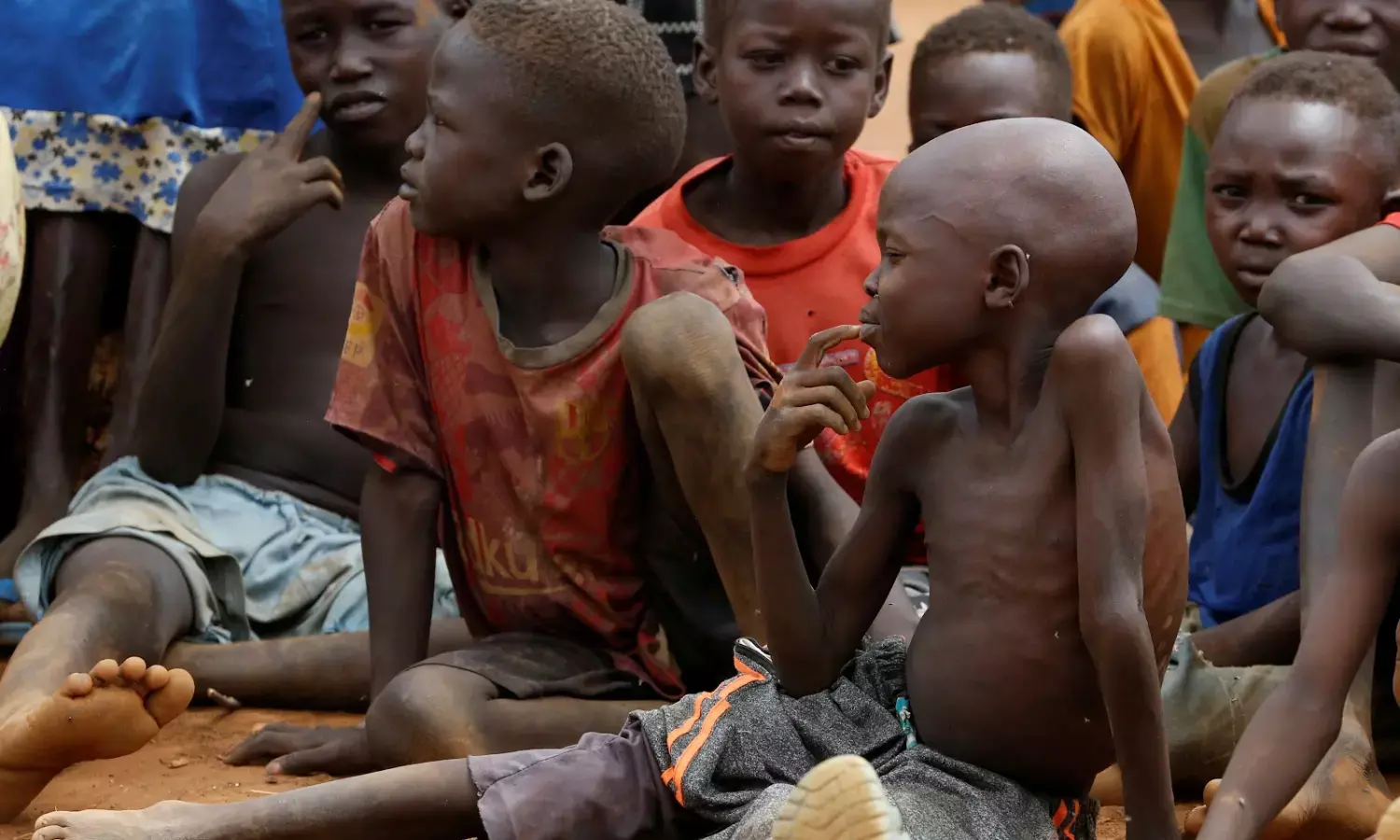
Millions of Sudanese are starving, caught in urban sieges and bombed markets, while aid convoys are looted and blocked. In Darfur, Khartoum, and across South Sudan, families are forced to survive on wild leaves, seeds, and animal feed. UNICEF reports children dying daily from malnutrition, while Médecins Sans Frontières warns that famine is spreading through refugee camps. Entire communities are on the brink of collapse, yet the world remains largely indifferent.
This crisis is not a natural disaster. It is man-made, the product of elite power struggles, systemic racism, and the weaponization of hunger. Sudan and South Sudan reveal the lethal consequences when political leaders treat human beings as expendable and the international community tolerates their brutality.
Sudan’s conflict has deep roots in its group politics. For decades, Khartoum’s ruling elites, identifying as Arab, excluded non-Arab African groups in Darfur, the Nuba Mountains, and Blue Nile from political participation and economic life. Language, religion, and ethnicity were mobilized as markers of superiority. Under Omar al-Bashir, this escalated into genocide. Militias such as the Janjaweed, later rebranded as the Rapid Support Forces (RSF), were unleashed to forcibly remove, terrorize, and kill African-identifying communities.
This racialized exclusion was not incidental—it was strategic. Peripheral regions, rich in resources like land, water, and oil, were treated as colonies. By framing African groups as “other,” the central government justified violence, displacement, and theft, consolidating power in Khartoum while leaving the peripheries destitute.
Eyewitnesses provide chilling testimony to the human cost. In El Fasher, one of Sudan's longest-besieged cities, a 75-year-old grandmother, Mariam Abdelghaffa, said simply, “We will never, ever escape.” The RSF’s siege has trapped over 260,000 residents, half of them children, without access to essential supplies. In Zamzam camp, survivors recounted the horrors to the media: “I walked over dismembered body parts and past incinerated neighbors as I fled,” describing an attack that killed hundreds and displaced tens of thousands. In Darfur, mothers like Houda Ali Mohammed recount the desperate struggle for survival: “We’re suffering. We have nothing to eat but animal fodder.” These media accounts make the abstract numbers of famine and displacement viscerally real.
South Sudan’s independence in 2011 was hailed as the end of Africa’s longest civil war. Yet the promise of freedom quickly turned into chaos. Tragically, it turned out to be a transition from Liberation to Famine. Leadership disputes between Salva Kiir, representing the Dinka, and Riek Machar, representing the Nuer, escalated into an ethnicized civil war, plunging the nation into famine. Oil revenues, intended to build infrastructure, schools, and hospitals, were siphoned off into military campaigns and personal networks of patronage.
Ordinary South Sudanese, who had endured generations of marginalization and conflict, became collateral damage. Communities faced food blockades, forced displacement, and deliberate starvation. Women suffered sexual violence used systematically as a weapon of war. By 2017, famine conditions affected nearly seven million people, a tragedy repeated because lessons from history were ignored.
Eyewitnesses highlight the devastating impact on children. At Bunj Hospital in Maban, a 14-month-old child named Adut Duor was admitted to the malnutrition ward. Hospital staff warned, “Children are bound to die without immediate intervention.” One refugee shared a heart-wrenching personal loss: “At the end of August, as I came back from school very hungry and ready for something to eat, my uncle called me to him and read me a letter telling us that my mother had died in Sudan. I felt very sorry and sad with deep sorrow. I screamed and rolled on the ground.” These testimonies bring the human suffering into sharp relief.
In today’s Sudan, starvation is not collateral damage - it is deliberate and used as a weapon. The ongoing war between the Sudanese Armed Forces and the RSF has trapped millions in cities where markets are bombed, farms abandoned, and essential supplies cut off. Families report eating seeds, leaves, and even livestock fodder to survive. Children are dying of preventable malnutrition, while hospitals, overwhelmed and underfunded, struggle to treat starvation-related illnesses.
Witnesses from Darfur camps describe horrific scenes: mothers collapsing from hunger, children showing signs of severe malnutrition, and the elderly left to fend for themselves. Aid agencies face constant obstruction, with convoys looted or blocked by militias. Starvation has become a tactical tool—a way to punish communities resisting control, force displacement, and break social cohesion.
The international community’s response has been pitifully inadequate. Western governments, quick to mobilize aid and sanctions for conflicts in Europe or the Middle East, display a glaring double standard in Sudan. Gulf states fund rival factions, betting on geopolitical leverage and resource access. China and Russia pursue oil and mining deals with little regard for civilian suffering. The United Nations issues statements of “grave concern,” yet its humanitarian appeals remain underfunded. The African Union calls for “African solutions,” but lacks the political will to confront armed factions and their foreign sponsors. Meanwhile, ordinary Sudanese starve as bureaucracies debate “complexities” and “conflict resolution.”
This selective attention exposes a racialized hierarchy of global concern. African lives are consistently discounted. If the same level of violence and starvation occurred in Europe, aid would pour in immediately, and headlines would dominate every international media outlet. In Sudan, millions die quietly, ignored by the world that claims to uphold human rights.
The current starvation crisis is not new. It is the story of historical lessons ignored. Darfur’s genocide from 2003 to 2005, the famine in South Sudan in 2017, and repeated civil wars have established a pattern: when elite power and resource exploitation collide with ethnic prejudice, ordinary people suffer the most. Despite repeated warnings from humanitarian organizations, the global system has failed to prevent recurrence. Starvation, displacement, and mass killings continue because the mechanisms to stop them are weak, underfunded, or politically constrained.
Starvation in Sudan and South Sudan is a crime, a tool of war, and a reflection of global hypocrisy. It is a direct consequence of leaders who see human beings as expendable, compounded by international actors who profit or remain silent. The world must not merely document suffering—it must act. For now, it is a moral responsibility shunned.
Humanitarian assistance must reach besieged populations immediately, and accountability measures should target leaders and militias who deliberately use starvation as a weapon. International investigations for war crimes, including famine-related offenses, are long overdue. Public pressure must prevent foreign powers from profiting off the misery of Sudanese civilians. Silence and inaction are complicity. African lives cannot remain invisible while starvation is normalized as a “consequence” of war.
Sudan and South Sudan exemplify the lethal combination of prejudice, elite power struggles, and international neglect. Starvation is deliberate, systemic, and politically orchestrated. The world’s apathy is a betrayal of basic humanity. The failure to act is not ignorance—it is choice. The question is simple: will the world allow these crimes to continue, or will it honor the lives of those caught in this engineered famine?
Ranjan Solomon is a political commentator and human rights activist. The views expressed here are the writer’s own.