

- >>
- OPINION
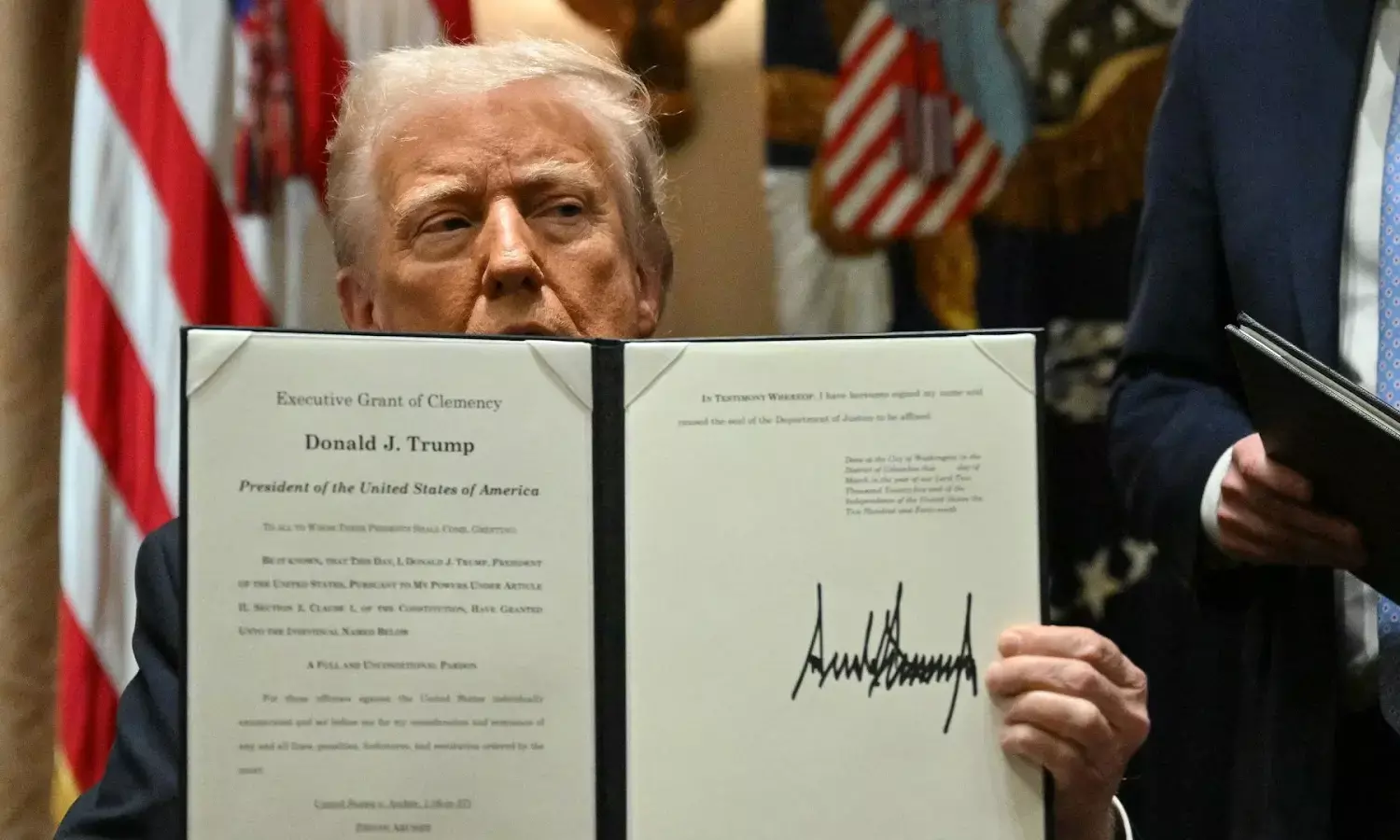
I stopped counting how many ethical red lines Trump has crossed since he reassumed office last January. He has mastered the art of exploiting the power of his office to serve his malignant narcissism and lust for power in endless ways. For him, the presidency is the means by which he can enrich himself and wield power at his whim with impunity.
Tragically, he cares less about the horrific long- and short-term implications of his misdeeds both domestically and internationally. Pardoning so many people arbitrarily, regardless of the nature of their crimes and irrespective of the rule of law, falls in line with many of his egregious executive orders only to feed his blind ego and assert his authoritarian instinct.
Just think, the very same day he reassumed office on January 20, 2025, he pardoned over 1,500 insurgents who attacked the Capitol on January 6, 2021, that he had instigated—an unprecedented attack in American history.
The building was invaded and ransacked, four rioters and one Capitol Police officer died on or immediately after January 6, and four additional police officers from the Capitol and the Metropolitan Police Departments died by suicide. And while the mob was calling for hanging his Vice President, Mike Pence, Trump, with a slimy grin, was watching the unfolding violent assault on the Capitol on TV for four hours before he agreed to call on his mob to end their attack and go home.
Here we have an unparalleled case in the annals of the presidency of the US, where a sitting President, who was impeached by the House of Representatives on January 13, 2021 for his incitement of the insurrection, ended up pardoning the convicted criminals who followed his maddening caprices. Beyond that, during the past 11 months alone, Trump issued sweeping pardons of 74 individuals and commuted the sentences of 15 others.
The framers of the Constitution granted the President the power to pardon any person for many legitimate and/or moral reasons. Still, it was never intended for such power to be exercised arbitrarily to serve the President's personal agenda. When examining all the pardons that Trump has granted, none fall within the categories that common moral sense permits or justifies.
Among the numerous justifiable reasons to grant a pardon are: correcting a judicial error, when there is evidence to suggest that the justice system was wrong and someone was unfairly convicted; showing mercy or compassion in cases where someone has already served a long sentence and has clearly been rehabilitated; and for reasons of public interest, wherein a pardon could help to heal political division or serve some broader social good.
Moreover, when laws are overly harsh, there is a need to pardon individuals for specific offenses to correct what might be seen as an injustice. When a law is no longer enforced or outdated and someone was convicted under such a law, a pardon can correct that historical inconsistency. Another is that when people were sentenced under rules that have since changed, like marijuana offenses that are no longer crimes in many states, pardons can correct that imbalance.
For Trump, though, there are no legal or moral guidelines for him to follow when choosing whom to pardon. For example, in October 2025, Trump pardoned Changpen Zhao for crypto-related money laundering violations. Zhao is the co-founder of a cryptocurrency exchange; in seeking the pardon, his company made business deals with the Trump family’s crypto startup, from which Trump and his family made hundreds of millions of dollars. Pure and simple, Trump traded America’s rule of law and justice for self-enrichment in broad daylight.
Another case of Trump’s outrageous pardons was his pardon in December 2025 of former Honduran President Juan Orlando Hernández, convicted of drug trafficking. Hernández claimed he had been a victim of persecution by Biden, which Trump’s press secretary, Karoline Leavitt, echoed in her announcement of the pardon.
Regardless of what might have motivated Trump to pardon him, the fact that he pardoned such a criminal when the US Navy is torpedoing boats allegedly loaded with drugs from Venezuela destined for the US is the apex of hypocrisy.
In December 2025, Trump pardoned Texas Representative Henry Cuellar (D) and his wife, convicted of bribery and conspiracy. Trump alleged that the Biden administration had persecuted Cuellar over Cuellar’s criticism of its border policies. Trump was likely counting on Cuellar to support his immigration policy and other Republican legislation, now that he owes his freedom to Trump. Only days later, Trump harshly criticized Cuellar’s “lack of LOYALTY” for the pardon, as Cuellar has announced his plans to run for reelection as a Democrat.
There are many reasons why arbitrarily pardoning individuals or groups of people would have a significant adverse impact, as it erodes the moral foundation of the legal system when it is capriciously applied. Such pardons undermine the idea that everyone is subject to the same laws, and accountability is corroded if pardons are handed out in a way that appears to protect allies or friends. It weakens the rule of law and the idea that officials are not accountable for misconduct. And overuse or perceived misuse of the pardon power can reduce trust and the fairness of the entire justice system.
In addition, it sets precedents; if one president uses pardons unrestrainedly, it encourages future presidents to do the same, leading to a slippery slope in which pardons are seen as a political favor rather than a rare act of justice or mercy. Finally, since the pardon power is a constitutional responsibility, when used without careful consideration, it can diminish the moral authority of the presidency and the integrity of the office and make it harder for future presidents to use that power legitimately without suspicion.
Perhaps there is no greater harm to the US resulting from Trump's outrageous pardons than their adverse impact on our friends and allies. Trump’s highly personal and arbitrary use of pardons undercuts perceptions of US rule of law and credibility, which in turn corrodes trust, coordination and leverage, especially with our democratic allies.
When a president repeatedly pardons political allies, ex officials, or figures tied, for example, to efforts to overturn an election, our allies see the US as less committed to impartial justice and effectively signals that those close to the president can commit crimes with impunity. This undermines the US’s image and weakens its moral authority to lecture others on the rule of law.
Pardons granted to politicians accused of acting as agents of foreign governments, such as Senator Bob Menendez, who was charged with accepting bribes from businessmen with ties to Egypt, make US anti-corruption diplomacy look hypocritical and weakens the US stance on corrupt regimes. When Washington pressures partners to prosecute graft while rescuing its own cronies, it makes allied governments less willing to cooperate, for example, on anti-money laundering initiatives.
Clemency for servicemembers accused or convicted of war crimes has already drawn criticism from military leaders and experts who argue it signals a lack of seriousness about the law of armed conflict. Allies who invest political capital in war crimes accountability can view such pardons as the US walking back standards of military conduct, complicating joint operations and support for international accountability mechanisms.
Trump’s willingness to advocate clemency for foreign leaders facing serious charges at home, such as former Brazilian President Bolsonaro or Israel’s Prime Minister Netanyahu—who are corrupt or authoritarian-leaning allies—reinforces the perception that personal loyalty to him matters more than democratic standards. This can embolden illiberal allies to repress opponents, expecting Washington to ignore it, thereby straining relations with other democratic partners.
If allies believe that individuals involved in, say, efforts to overturn an election can be wiped clean with a stroke of the pen, they will be more cautious about sharing intelligence and providing sensitive political support. Arbitrary, self-serving pardons deepen perceptions of US political volatility, reduce policy coordination, and make partners less willing to follow US leads in law enforcement cooperation.
Many measures can be taken to rein in Trump’s arbitrary and unseemly pardons. However, several of these measures require congressional action and would not pass because both chambers are currently Republican-dominated.
This includes impeachment, making the use of pardons as bribery a clear federal crime, requiring Senate consent for particular high-risk pardons, and using aggressive congressional oversight hearings to monitor pardons. That said, there are still several practical measures that Congressional and state Democratic officials can take that do not require congressional approval, including:
- Coordinating with state prosecutors, who are unaffected by federal pardons, to pursue state-level charges and civil actions against pardoned offenders,
- Encouraging aggressive state criminal and civil actions against Trump allies whose conduct violates state law, since federal pardons cannot erase state liability or penalties,
- Filing state and federal bar complaints against lawyers who helped engineer corrupt pardons, seeking disbarment or sanctions through professional discipline bodies independent of Congress,
- Pursuing criminal investigations of Trump’s intermediaries for bribery, obstruction, or witness tampering surrounding specific pardons, arguing that corruptly obtained pardons can themselves be prosecuted,
- Mounting statutory challenges in federal court to especially egregious pardons—arguing they violate due process, equal protection, or criminal statutes and are therefore invalid or limited in effect.
Sadly, we have not yet seen the end of Trump’s barrage of arbitrary and destructive pardons, nor his domestic and foreign mischiefs, nor his violation of the Constitution. Although many of his transgressions can be reined in temporarily by the courts, in the final analysis, only if the Democrats manage to wrest control of the House and the Senate in the next midterm election will the sun begin to set on the most infamous president in American history.
Alon Ben-Meir is an American expert on Middle East politics and affairs, specializing in peace negotiations between Israel and the Arab states. The views expressed here are the writer’s own.