

- >>
- OPINION
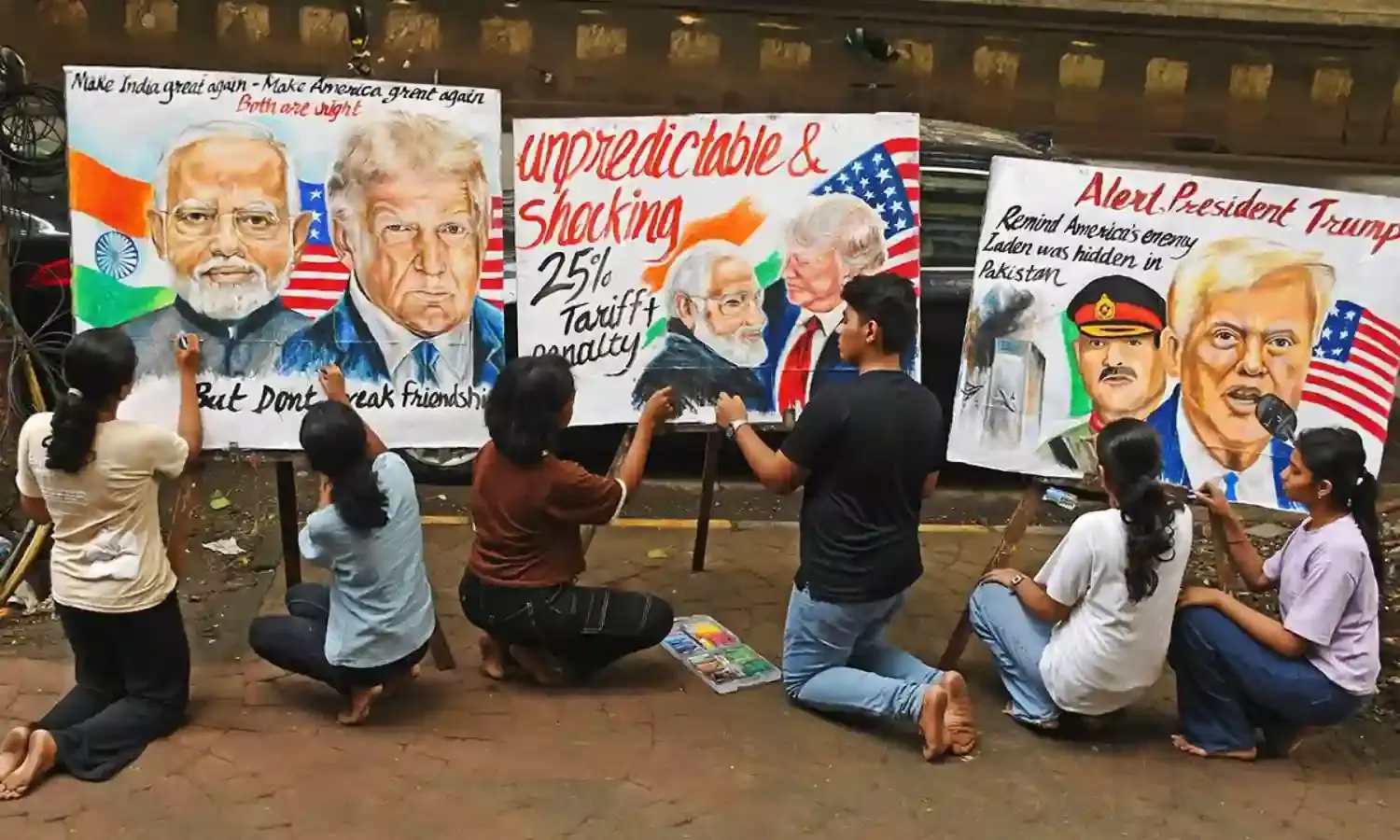
US President Donald Trump seems to have shed all the chemistry that India had credited him with, withdrawn the embrace from Indian Prime Minister Narendra Modi, and emerged as an India-baiter that the mandarins in the Foreign office here had not anticipated. He slapped a 25 Per cent tariff on India, doubled it to 50 per cent, and within days - or was it hours?- made it clear that the visit of the US delegation to India scheduled earlier for August end will not happen. His references to India have been far from friendly, starting with criticising Apple for opening centres in India to hinting at a lot more.
It is interesting how this relationship between the two leaders dissolved in minutes. Till February this year it was still moving well - despite the fact that the Indian PM had not attended a Trump event when he was in the opposition in the US - and both were promising each other the moon. The Indian Foreign Office stress on body language, and chemistry remained with the legacy media echoing the projection in even more glowing language until the terrible terror attack by Pakistan on the hapless tourists in Pulwama. The government found itself under tremendous pressure from its own supporters to open fire at Pakistan, and went out with all guns blazing. Pakistan responded in kind, and the world held its breath as the two nuclear neighbours continued to spit and hiss at each other.
And then as suddenly as it began, a ceasefire was announced by Trump and the two militaries paused. US President Trump took full credit, and after a short hiatus, the Indian government responded with the assertion that it had pulled back at its own volition, and the ceasefire was not at anyone’s behest. Trolls came out attacking Trump for daring to take credit for something he had not done; and our famous television anchors were on prime time attacking the US President and even asking, “who is Trump?” The proxy attack — as the government here did not want to rock the boat directly, is reported to have angered the US President who does not believe in the niceties of diplomacy. It is very clear to all those who deal with him that he does not like opposition, and slams back hard.
So he retaliated - not once but 30 times and still counting - at meetings and press conferences to underline his involvement in the India-Pakistan truce. And that he used trade as the weapon to get them both to draw back. However, while Pakistan had no hesitation to "appreciate" Trump for his mediation, India decided to refute it, if not directly then through its proxies. In Parliament just a few days ago, Leader of the Opposition Rahul Gandhi played on this vulnerable nerve by repeatedly insisting that the Prime Minister break his silence and call Trump a liar for making these claims.
Meanwhile talks are still on. But it is not clear what will assuage Trump’s sentiments. Defence deals this time around do not seem as important as the US intention to enter the Indian agricultural sector, and in a sense own it. This pressure is being exerted by Washington, a demand that New Delhi cannot accede to without losing the elections at home. The farmers are a huge lobby as their protests have amply demonstrated and will not tolerate any dairy take over any concessions by India to the US in this all important sector.
Several analysts have written about the fact that Trump’s tariffs to India reflect a pique that needs to be addressed. And is not related directly to the reasons he has offered. For instance the additional 25 per cent on India for purchasing Russian oil makes little sense as China, for instance, imports far more than India. Besides India, after concurrence from the US earlier, had been buying Russia oil at cheap rates and exporting it to the European countries that had stopped direct purchasing because of the Ukraine war.
Alongside , as the Washington Post has reported, “Trump’s annoyance appears to have opened the door to anti-India sentiment from multiple quarters in the White House. For economic right-wingers such as Peter Navarro, Trump’s senior counselor for trade and manufacturing, long-held gripes about India’s protectionist economy and high trade barriers are finally seeing the light of day. And for the anti-immigration right — people including Stephen Miller, Trump’s deputy chief of staff — India is in the crosshairs as the largest beneficiary of the H-1B visa program, which offers skilled foreign workers a pathway to U.S. permanent residency.”
Trump has also influenced the world opinion to look at India and Pakistan as a hyphenated relationship after the conflict, equating both in his references to the ceasefire. There was no effort to differentiate between the two, by bringing in terrorism that India has always accused Pakistan of. And in fact, at one point in time, succeeded in getting all world capitals to condemn Pakistan generated terrorism in strong language. This suddenly seemed to have become a position of the past, with the same world capitals following Trump in calling on India-Pakistan to stop the hostilities and withdraw their militaries.
Trump to further spite India — at least that is how the strategic establishment here is reading it–invited Pakistan's Chief of Army Staff over for lunch to the White House. And as if that was not enough he had a second meeting with him lately in a message that the two countries are working together, and Trump’s embrace was now reserved for the Pakistan Army General (a self proclaimed Field Marshal after Operation Sindoor ended). To put it briefly, the US-Pakistan relationship has grown exponentially since the conflict, and the chemistry that our mandarins have always applauded seems to have shifted now to Munir.
India seems to be inextricably tied to the US, with the civil nuclear energy agreement pushed by former Prime Minister Manmohan Singh having sealed our fate. Economically, if the 50 per cent tariff comes into effect, the Indian economy will be hit hard with lakhs of persons rendered jobless. Middle level industries will collapse and their workers will flood the roads of unemployment. The expected scenario is dismal but then there are other issues that a leader like Trump can and perhaps will play with. The list is long and includes legal cases going on here against India’s interests; visas and jobs for Indians that are any way under threat; and then of course Kashmir that Trump has already mentioned as an issue in his ceasefire announcements.
How did things come to such a pass? From the rah rah to the bitter acrimony? Perhaps our Minister of External Affairs Jaishankar will have the answers, as we hacks can just speculate. But one it has to do with ‘chemistry’ a word that has gradually gathered momentum in South Block. It would have been fine had it been limited to vocabulary, but it has unfortunately impacted the perceptions of our diplomats with the media exaggeration and emphasis virtually embedding this as a diplomatic tool. Huge effort was expended on establishing this chemistry, that reached levels intended to stupify. And in the process it seems that those in charge of our diplomacy forgot to understand Trump in his second avatar as the US President.
He has come through as a very different person in his actions. Some of it was visible after he had lost the elections in the mob attack on Capitol Hill, and this term seems to be an extension of that show of muscle. Trump has made it clear that materialism and not personalities will drive him, and he can kiss and make up with Russia’s Vladimir Putin if that suits his particular brand of politics. Russia, by the way, is dealing with just 10 per cent tariffs. Two, that he will browbeat all who come in his way and can calm down only with money and open public gratitude from those he offers concessions or does something for. His meeting with Ukrainian president Zelensky turned hostile at the White House itself because he felt — his vice president voiced it for him at the time— that Zelensky had not said thank you!
If our diplomats had read him right they could have changed the shift from chemistry to management. And understood that the old Trump was now a new Trump who expected not equality, but deference. And thank you at every turn of the corner, not questions or denials. India faulted on both after the ceasefire, with the Republican who is driving his country to the ground not hesitating to call her out.
The choice then was to manage Trump for his term in office, and keep the relationship going. An opportunity that has been exercised by several European countries whose leaders have visited him, smiled at his comments that even his own countrymen have issues with, and left with the goodies intact. Or confronted him for the sake of their domestic constituencies but then you have to be a China to do that and succeed. Or Canada that decided to bite the bitter bullet and not succumb.
So Jaishankar and his team will have to decide on the basis of a) what is the worst case scenario if we bite the bullet, and can we withstand it politically and strategically? An honest and brutal assessment and not a cover up of any kind .Chances are such an assessment will throw up a resounding ‘not possible’ response as the consequences of a complete rift will be dire. Trump has already indicated this with his embrace of Munir and Pakistan. Plus his veiled threats that emerge every now and again with ‘there will be more, a lot more’ kind of remarks.
And so we come to b). Accepting that the consequences will be tough, Jaishankar after explaining it to the political leadership in open words will have to then pass the ball into their court. To basically centre around, are we willing to extricate ourselves from the US stranglehold or is that too tough a choice. If the last, then of course the story is over in that Trump will move fast to tighten the stranglehold, perhaps even in the dairy and agriculture sectors.
Or are we prepared to brazen it out, and move our alignments towards BRICS which has not lost its courage despite the US assault. and strengthen ties with Russia and cool relations with China? This option needs not just proper thinking, but strategising every step along the way. It will be tough to handle the US wrath as it were; and develop trust in a region where we have always been seen as a reluctant partner, and in China’s case even a foe. This, however, might bring us back on the path of true non-alignment, more space to further our national interests, and a certain independence that India had looked for when she gained independence.